 MindLynx
Anthropic Grew 80x Year on Year. Meta Cut 8,000. Please Let's Get on the Right Side of This Story.
Cost, revenue and compliance are coming for every business at once, and most boards are looking at one. The revenue opportunity, the cost side, the price of not acting on compliance, and the people in the middle of it.
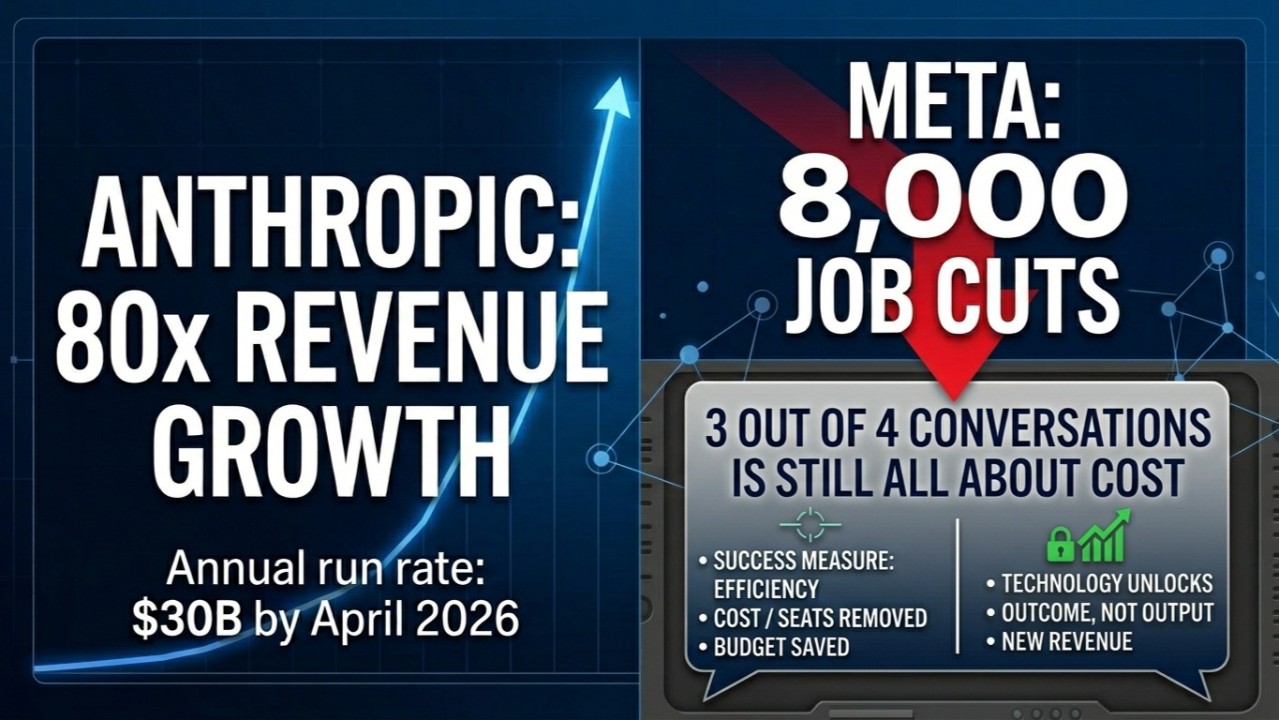
Three forces are coming for every business at once: cost, revenue, and compliance. Most boards are looking at one. That is the wrong side of the story.
Four conversations this past week.
In three of them, the only success measure on the table was efficiency. Which really meant cost. And eventually means people. How much could come out of operations. How many seats could be removed. How much budget could be saved by year end.
One conversation was different. We talked about what the technology actually unlocks, how we make money from it, and what outcomes we are trying to achieve. Not “can we ship the best code.” Not “can we build a product that looks fantastic.” The question was: can we achieve what we set out to achieve. Outcome, not output. You know who you are.
Unfortunately, that conversation is the exception rather than the rule.
Cost and efficiency is one third of what we need to focus on. In my experience, boardrooms and leadership teams generally only focus on that one third. That is the wrong side of the story.
Four numbers landed this week that prove the point.
Anthropic grew 80 times year on year. Annual revenue run rate moved from roughly nine billion dollars at the end of 2025 to thirty billion by April. Dario Amodei called it “just crazy” and “too hard to handle.”
Meta will begin cutting 8,000 jobs from 20 May. That follows almost 37,000 US layoffs in the first ten days of May. Challenger, Gray & Christmas confirmed AI as the most-cited driver of cuts for the second consecutive month.
JPMorgan formally reclassified AI out of research and development and into core infrastructure. 1.2 billion dollars tagged to AI inside a 19.8 billion technology budget. Jamie Dimon admitted, on the record, that “AI returns are difficult to quantify.” The bank is spending the money anyway.
GitLab announced “Act 2.” Flatten management. Reorganise R&D into 60 small autonomous teams. Cut country footprint by 30 percent. CEO Bill Staples called it reinvestment for the agentic era, not a cost-cutting exercise. The market read it as a layoff anyway and the shares slid. That is also part of the story.
Four signals. Same week. Same direction. Three forces moving at once.
The revenue side. The opportunity.
Thirty billion at Anthropic is not a vendor story. It is a budget story. That money does not appear from nowhere. It is enterprise procurement redirecting spend from headcount, consultancy, and software licences. The customers paying it are paying because the systems they are building on top of these models are generating revenue on the other end. New customer segments. New geographies with smaller teams. New pricing models capturing value that previously could not be captured.
Dario’s framing matters. “Too hard to handle” is the language of scarcity, not demand. The two-hundred-billion-dollar Google Cloud deal, the SpaceX Colossus 1 capacity, the Akamai 1.8 billion deal, are the substrate underneath a curve no one predicted. The constraint is compute. Not customers.
GitLab is the operating-model proof of the same point. Bill Staples did not announce a layoff. He announced the consequence of a position the company had already taken about how software is built in the agentic era. Three management layers came out because three layers are not the right shape for sixty autonomous teams. The country footprint shrank because operating in sixty countries is the shape of a coordination-heavy organisation, not a speed-heavy one. A public software company stood in front of its investors and said: the shape of the work has changed, and the shape of the company needs to change with it. That sentence will be repeated by several hundred companies over the next two years.
Profit will catch up. As coordination costs collapse, the gap between revenue and cost-to-serve widens for the businesses that have rebuilt themselves. ROI was always a matter of time, not a matter of doubt.
The cost side. The half the boardroom already knows.
The cost story is real. The Meta cuts are real. JPMorgan’s reclassification is the boardroom signal that the conversation about whether to spend is over. Dimon’s quiet admission that returns are difficult to quantify is the most important sentence a bank CEO has said about AI all year. The world’s most sophisticated institution cannot prove the ROI in conventional terms, and is spending anyway. That is conviction in the face of imperfect information. That is what investment looks like at the start of a regime change.
But cost is one third of the page. The boards still anchored on it alone are running 2024 mental models against 2026 unit economics.
The compliance side. The cost of not acting is an opportunity you will not get back.
This is the force most boards are quietly treating as someone else’s problem. It is not.
The King’s Speech on Wednesday confirmed the AI Growth Lab as legislated regulatory sandbox territory, and committed for the first time to legislate on “the most powerful AI models.” The Open Rights Group pushed back, arguing the framing leaves gaps and that talk of “targeted reforms to some data laws” could weaken ADM safeguards. The speech is not uniform tightening. Parts of it loosen. The signal is still significant.
Two weeks later, on 29 May, the ICO consultation on automated decision-making in recruitment closes. The ICO has already signalled that most UK employers running AI in recruitment are making decisions with legal or significant effects without meaningful human involvement. Almost every FTSE 350 HR function is exposed, and almost none of them can answer it cleanly today.
Ten weeks after that, on 2 August, the EU AI Act high-risk obligations enter into force. Last week’s Council agreement softened some provisions, but the August enforcement date did not move. Companies reading the slippage as permission to wait will be the ones rushing in late 2026 to build controls they should have built this year.
Three regulatory moments in a ninety-day window. Add the security backdrop: Anthropic’s Mythos preview surfaced thousands of zero-day vulnerabilities. The Fed and Treasury convened bank CEOs. AI-orchestrated breaches hit 600 FortiGate firewalls across 55 countries in five weeks, run by a low-to-medium-skilled actor using commercial generative AI tools. This is no longer theoretical.
Companies that build the compliance posture early can sell into regulated industries the others cannot reach. They can deploy what they have built, when they have built it, without an 18-month retrofit. The companies that wait will discover, late, that they have built systems they cannot defend.
I sat with the King’s Speech yesterday afternoon. What struck me was not the AI Growth Lab announcement. It was the “most powerful AI” line, the first time a UK government has explicitly framed frontier safety as legislative territory. Compliance has gone from the question nobody wanted to be in the meeting for, to the question that decides whether the deployment happens at all. The change happened fast.
There are people in the middle of this.
The 8,000 at Meta are not a statistic. The 37,000 across the first ten days of May are not a statistic.
LinkedIn is processing 14,200 job applications per minute in 2026. The average job seeker is now submitting 27 applications to get one first-round interview, up from 11 in 2021. Corporate postings see 200 to 260 applicants per role. Nearly 80 percent of people told LinkedIn they feel unprepared to find a job this year.
AI is in this conversation, but it is not the whole story. Challenger confirmed 26 percent of April’s cuts cited AI. The other 74 percent did not. Some of those cuts are genuine cost discipline. Some are boards claiming the AI benefit before the maturity is there, which is the version that frustrates me most, because the people leaving carry the cost of a productivity gain that has not yet been earned.
If you are in the middle of that, the most useful thing you can do is understand what is happening in AI and how to use it. The systems screening your applications are sorting, ranking and routing your CV before a human reads it. The right response is not to be angry at the algorithm. It is to understand how it works. The deeper move is to learn how to operate as part of a hybrid team. That skill is the lever, whether you are running a 5,000-person business or rewriting your CV next week.
Preparing for the changes already underway
Four moves, in priority order.
Change the CFO conversation around all three forces. Cost, revenue, and compliance. Not just cost.
Reclassify AI on the capital allocation pages. Out of innovation. Onto core infrastructure. JPMorgan has shown the way.
Redesign the topology before the agents arrive in volume. Agents do not slot into the shape of the organisation you already have. They reshape it.
Build the personal and team skill of operating in hybrid mode. What are you doing today, with what tools, that you could not do six months ago? The people who can answer that crisply are the people who are preparing well.
The skill is the lever. The signals are the urgency.
Four signals this week. Anthropic grew 80 times year on year. Meta cut 8,000. JPMorgan made AI core infrastructure. GitLab restructured into the agentic era. Three forces moving at once: cost, revenue, and compliance.
I am watching four things over the next ninety days. Which sectors get the first AI Growth Lab sandbox slots. Whether the ICO guidance lands hard or soft on 29 May. Whether a second public software company follows GitLab into a topology redesign. Whether Anthropic’s growth curve breaks above thirty billion or holds there.
The time is short. The signals are loud. Please, let’s get on the right side of this story.
First published on LinkedIn, 14 May 2026.