 MindLynx
AI Didn't Just Change the Work. It Changed the Shape of Organisations.
Block cut nearly half its workforce and pointed to AI. Why cutting headcount while keeping the old structure is not a transformation, and the four parts of the redesign: strategy, structure, risk and culture.

For the last thirty years, companies scaled by hiring more people. The companies that define the next decade will scale by amplifying fewer people.
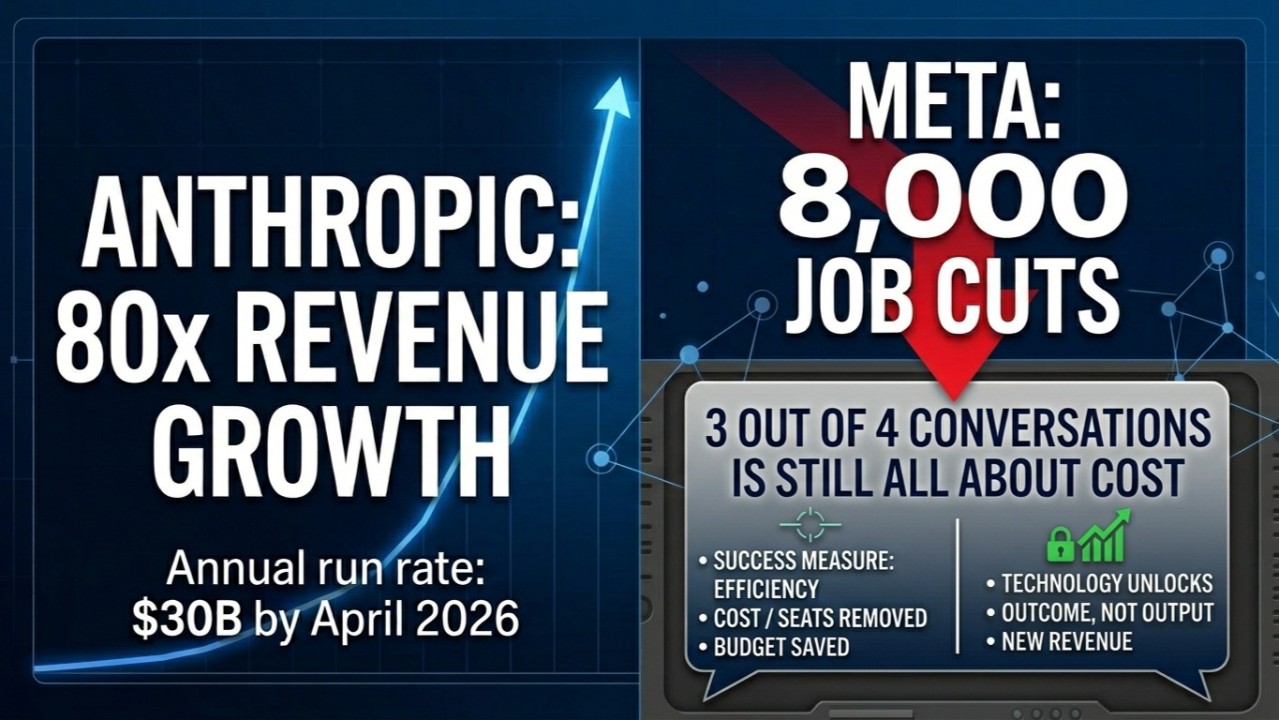
In February, Block eliminated roughly 4,000 jobs. Nearly half its workforce. CEO Jack Dorsey was unusually direct about why. He pointed to a step change in AI capability that arrived in late 2025 and said the company could now operate more effectively with a significantly smaller team. The business wasn’t struggling. Gross profit had more than doubled through the year. Dorsey then predicted that most companies would reach the same conclusion within twelve months.
He may be right about the timeline. But I think the conclusion most companies are drawing is incomplete.
Within days of Block’s announcement, Oracle confirmed plans to cut between 20,000 and 30,000 roles, as much as 18% of its global workforce, to redirect billions toward AI data centre infrastructure. Microsoft has executed layoffs affecting 15,000 employees across sales and engineering. Amazon eliminated 16,000 corporate roles at the start of the year on top of 14,000 cut in late 2025. WiseTech Global, the Australian logistics software firm, cut 2,000.
By the end of March 2026, more than 45,000 tech workers globally have lost their jobs. Roughly one in five of those cuts are explicitly tied to AI and automation.
And almost every company is framing it identically: efficiency. Same mission, fewer people, better margins.
Difficult choices
To be honest, I’ve been on both sides of these decisions. So I’m not here to tell anyone that layoffs are always wrong. That would be naive. Companies face real margin pressure. Investors are rightfully demanding productivity improvements. AI infrastructure is extraordinarily expensive. Oracle is spending billions on sovereign AI alone. Payroll is the largest controllable expense on most balance sheets. In that environment, headcount reduction is sometimes the right lever to pull.
But here’s the distinction that matters: reducing headcount can be a necessary part of a restructure. It should never be the whole restructure.
Because cutting people while leaving the organisational structure intact is not transformation. It’s amputation. You lose the weight but keep the shape. And the shape is the problem.
The thread connecting this series
If you’ve been following my writing, you can see where this is heading.
In Is SaaSpocalypse Real?, I explored how AI-native companies are rewriting the economics of software. Revenue per employee at companies like Cursor ($3.3 million), Midjourney ($2 million+), and ElevenLabs is running at multiples that would have seemed absurd three years ago. Traditional SaaS still averages around $600,000.
In Changing Operating Models Isn’t a Choice. It’s Survival., I argued that the operating model, not the technology, is where transformation succeeds or fails. Tools are commodities. How you organise work is the differentiator.
This piece is where those two arguments converge. If the economics have shifted by an order of magnitude and the operating model has to change, then the organisational structure itself has to change with it. The way people, decisions, and accountability are arranged needs to reflect the new economics.
What I see instead is companies reducing headcount while preserving the structure that made those people expensive to coordinate in the first place. Six months later, the remaining teams are overloaded, institutional knowledge has walked out the door, and nothing actually moves faster.
The economics that make the old structure untenable
For most of the modern enterprise era, each employee generated roughly $200,000 to $500,000 a year in enterprise value. That ratio shaped everything about how organisations were designed.
You could afford management layers because the coordination cost was modest relative to each person’s output. Cross-functional alignment meetings, steering committees, weekly status updates. These were overhead, but tolerable overhead. The coordination tax was a rounding error against the value being created.
AI broke that ratio.
Klarna is the clearest example. Revenue per employee has gone from $300,000 to $1.24 million since 2022. That’s a 152% increase. Their AI chatbot absorbed work equivalent to 700 customer service agents. CEO Sebastian Siemiatkowski now expects the company to shrink from 3,000 to 2,000 employees by 2030 while continuing to grow revenue. Operating expenses fell 8% while revenue grew 104%.
Duolingo tells a different version of the same story. They cut contractors but haven’t laid off a single full-time employee. Instead, CEO Luis von Ahn says AI makes each person four to five times more productive. Same headcount, dramatically more output.
When each person produces four to five times more value than they did three years ago, every piece of organisational overhead costs four to five times more in relative terms.
That standup where five people spend thirty minutes synchronising? When those people each generated $250,000 a year, the meeting cost roughly $150 in collective productivity. When they each generate $1 million, that same meeting costs $600. Scale that across every recurring meeting in your calendar and the numbers become staggering.
The alignment session where eight people attend and two people talk. The project manager whose role exists because the team is too large to self-coordinate. The management layer that manages the management layer. All of it was designed for a $250,000-per-person economy.
We’re now in a $1-2 million-per-person economy. The structure hasn’t caught up.
Your methodology was built for a different bottleneck
Here’s something that isn’t getting enough attention. The entire framework most organisations use to manage work was designed for a constraint that no longer exists.
Agile emerged to solve a specific problem: how to coordinate knowledge workers building complex products in uncertain environments. The answer was short cycles, constant communication, rapid iteration. Scrum, sprints, standups, retrospectives. Every ceremony exists to reduce the friction of human coordination and execution speed.
That framework assumed the bottleneck was how fast humans could build things.
AI removed that bottleneck.
When a working prototype can be produced in an afternoon, what does a two-week sprint buy you? When a team of four shares context naturally because they’re small enough to hold the whole system in their heads, what does the daily standup add? When AI can generate, test, and iterate code faster than a team can discuss it, what role does velocity tracking play?
One senior Agile practitioner put it bluntly. The biggest threat isn’t that AI replaces Agile practitioners. It’s that AI reveals what many organisations have quietly suspected. They never needed the Agile practitioners. They needed the Agile thinking. The ceremonies had become theatre.
I’m not arguing that Agile is dead. The principles of responding to change, of working software over documentation, of collaboration over process are arguably more relevant than ever. But the ceremonies and structures built around those principles assumed human execution speed was the constraint. When AI compresses build cycles from weeks to hours, the rituals need to evolve too.
The real question is this. If execution is no longer the bottleneck, what is?
The answer, consistently, is correctness and accuracy.
A Harvard Business School study of 776 professionals at Procter & Gamble found that teams using AI were three times more likely to produce ideas in the top 10% of quality. Not three times more output. Three times more likely to be right. The researchers also found that AI extended each person’s competence into adjacent domains, breaking the functional silos that traditional org design creates and that Agile ceremonies try to bridge.
Volume is cheap. AI generates volume effortlessly. What’s scarce is whether the thing you shipped is architecturally sound, strategically coherent, and right for the customer. Whether it works in production, not just in a demo.
The organisations that win going forward will optimise for correctness, not speed. And that requires a fundamentally different structure than the one most companies are running.
The four dimensions of the redesign
The restructuring that’s actually needed goes deeper than headcount. It touches four dimensions that most leaders aren’t confronting simultaneously.
Strategy: from efficiency to expanded ambition
Most companies frame AI as a cost story. How do we do the same work with fewer people?
That question is rational. It’s also incomplete.
If AI makes each person four to five times more productive, a company with 500 employees suddenly has the productive capacity of 2,000 to 2,500 without raising capital, hiring, or building new offices. That’s not a cost reduction. That’s a capability expansion.
The strategic question isn’t “how do we get leaner?” It’s “what was previously impossible that’s now possible?”
Think of a SaaS company with 400 engineers maintaining one product. Restructured into smaller autonomous teams, each owning a distinct product area, could they build a platform of ten products? Think of a UK insurer serving three regions. Reorganised around AI-augmented teams, could they serve fifteen?
AI should impact both sides of the P&L. The cost line, yes. Operational friction falls. But the revenue line too. More products. Faster launches. Adjacent markets. New services that weren’t economically viable when every initiative required a department.
If AI only reduces cost, companies get leaner. If AI increases capability as well, companies get more ambitious. The second outcome is more interesting and more valuable. In reality, most organisations will land somewhere in the middle. But the ones that frame AI purely as cost reduction will leave the bigger opportunity untouched.
Deloitte’s latest State of AI in the Enterprise report confirms the gap. 88% of organisations use AI, but almost two-thirds haven’t implemented it at scale, and only 39% can demonstrate a quantifiable impact on earnings. The tools are there. The strategic imagination isn’t.
Structure: smaller units, broader capability
The traditional org chart of functional departments, reporting lines, and matrix management was designed for a world where coordinating large groups of humans was the central challenge. AI changes the equation. When much of the execution is AI-augmented, the central challenge shifts to judgment, coherence, and quality.
Nate B Jones has written thoughtfully about how AI compresses effective team sizes. I agree with the direction of that argument, but I think the deeper shift goes beyond team size alone. It’s about the architecture of the organisation. How autonomous units relate to each other. How decisions flow. How coherence is maintained across many small teams instead of a few large departments.
Two patterns are emerging for how these units operate. Scout teams, very small, one or two people with full AI tooling, explore problems the company hasn’t addressed yet. They prototype, test viability, map territory. They move fast because they carry almost no coordination overhead. Their output is insight, not production.
Strike teams of five people, cross-functional by default, build for production where correctness matters. Product, engineering, design, data, and domain expertise all represented, though not necessarily one person per discipline. AI extends each person’s range. The team is small enough that everyone holds the whole system in their heads. There’s nowhere to hide. That’s the point.
Between these units sits what matters most. People obsessed with owning the problem and maintaining the standard of what good looks like. In an organisation of many small autonomous teams, the people who define and enforce quality standards are the most important people in the building.
This is important though: the power of these smaller units depends entirely on the calibre of the people inside them. Five average performers with AI tooling don’t outperform a traditional team. Five people with exceptional judgment, deep domain knowledge, and the ability to direct AI at the right problems absolutely can. The shift is not just about smaller teams. It’s about talent density inside those teams.
This isn’t theory. In the UK alone, one in six employers plan AI-related workforce restructuring in 2026. UK fintechs like Monzo are investing heavily in AI. Their machine learning systems prevented 2.9 times the value of unauthorised fraud this year compared to last. The restructuring is already underway. The question is whether it’s being done with architectural intent or just financial pressure.
Risk: what breaks when you restructure
Every restructuring carries risk. I know this firsthand. When I had to reduce a team by a third, we lost people whose institutional knowledge took months to recover. Some of those cuts were necessary and right. Others, in hindsight, cost us capabilities we didn’t fully appreciate until they were gone.
The AI-driven version of this carries risks that most leaders underestimate.
There’s execution risk. You reorganise, break functioning teams, and lose knowledge you can’t recover. Bloomberg has raised questions about whether Block’s cuts are genuine AI-driven restructuring or “AI-washing,” standard cost reduction dressed in AI language. When companies cut their policy teams and diversity roles and call it AI transformation, the scepticism is earned.
There’s cultural risk. Only 39% of middle managers actively support organisational change. When they’re excluded from planning, resistance doesn’t announce itself. Researchers call it silent non-compliance. They don’t fight the change. They just don’t implement it. Gartner found that 50% of failed transformations are due to misalignment between business units. Silos are defended territories, and restructuring into cross-functional units means crossing every one of them.
And there’s a structural risk that nobody talks about enough. Even leaders who understand the theory of smaller units, expanded ambition, and correctness over volume have no operational framework for executing the transition. How do you form these new teams? How do you redeploy people? How do you maintain coherence across forty autonomous units that used to be four departments? How do you track what’s working?
The tooling and methodology for managing this kind of restructuring at enterprise scale barely exists. Most organisations are navigating this transition with spreadsheets, instinct, and hope. The companies that build or adopt operational frameworks for this, real systems for composing, tracking, and coordinating AI-augmented organisations, will have an enormous head start. And right now, almost nobody has one.
Culture: from coordination to judgment
This is the dimension that determines whether everything else works.
The World Economic Forum’s 2026 report on AI at Work makes the case directly. AI strategy can no longer be a technology roadmap. It must be a people strategy. How decisions get made. How skills develop. How accountability works. How trust is maintained when AI produces the first draft of everything.
The cultural shift required is fundamental. Traditional organisations reward people who navigate process. Running meetings, managing stakeholders, writing status updates, maintaining alignment across large groups. Those are coordination skills. Valuable in a large structure. Overhead in a small one.
AI-augmented organisations reward something different: judgment. Can you look at AI-generated output and spot the subtle error that looks correct but isn’t? Can you hold the whole system in your head? Can you define a problem without being handed a specification? Can you make a decision under genuine uncertainty?
Shopify’s Toby Lütke institutionalised this. He required every team to prototype with AI before beginning a real build. AI fluency became part of performance reviews. Teams had to demonstrate why AI couldn’t do a task before requesting headcount. The surface reading is a CEO pushing AI adoption. The deeper reading is that he built a systematic pipeline for discovering what AI can and can’t do. And every forced prototype trained exactly the judgment skills the new structure requires.
Some of an organisation’s highest-rated people, the ones brilliant at navigating large structures, excellent in meetings, meticulous with status updates, may struggle in smaller, flatter, faster units. Meanwhile, the most frustrating employees, the ones who skip meetings, build things without asking, and occasionally ship something brilliant that nobody requested, may be exactly who the new structure needs. They’ve been fighting the old organisation for years.
What leaders can do this week
If this resonates but feels overwhelming, four moves can reveal a great deal without requiring a company-wide restructuring.
Run a pathfinder mission. Pick a problem your company has been ignoring. Give one person full AI tooling, a clear objective, one week, and zero committees. What you’re testing for isn’t whether AI can solve the problem. It’s whether your people can direct it. Can they define the problem independently? Do they default to action or to seeking permission?
Prototype a strike team. Take five of your strongest people across functions. Give them a real business problem with real consequences. Not an innovation lab. Remove the coordination overhead. No programme manager, no weekly steering committee, no status report. The results will tell you more about your organisation’s readiness for native AI.
Audit your coordination tax. Not to shorten meetings or add AI note-takers. Ask the harder question: which of these meetings exist because too many people are involved in this decision? If the team were five people with full context, which meetings simply wouldn’t need to happen? Calculate the cost in terms of what those people could be producing instead.
Question your methodology, not just your tooling. If you’re running two-week sprints and AI can produce a working prototype in an afternoon, what is the sprint actually buying you? If your standups synchronise ten people and six of them don’t need to be there, what happens if the team is four people who share context naturally? The answer isn’t to abandon Agile. It’s to recognise the economic assumptions underneath your methodology have shifted and ask whether the ceremonies are still earning their place.
The question that will define the next decade
For the last thirty years, companies scaled by hiring more people. The companies that define the next decade will scale by amplifying fewer people.
Cutting is subtraction. Restructuring is architecture. One makes you smaller. The other makes you capable of things you couldn’t previously attempt.
Dorsey says most companies will reach the same conclusion within a year. Maybe. But “how small can we get?” is a cost question. It protects margins on your current ambition.
The more interesting question, the one that separates the companies that define this era from the ones that get left behind, is this:
What becomes possible when every small team has the productive capacity of an entire department?
The answer reshapes strategy, structure, risk management, and culture simultaneously. It demands a different kind of organisation. And it demands a different kind of person inside that organisation.
Which raises the question I’ll explore next week. If organisations become smaller, more autonomous, and heavily augmented by AI, what skills actually matter inside those teams? Because the people who succeed in this structure will not necessarily be the ones who succeeded in the previous one.
First published on LinkedIn, 10 March 2026.