 MindLynx
Jack Dorsey Thinks Middle Management Is Finished. He's Half Right.
Jack Dorsey argues the hierarchy will give way to a company world model. He is right that the hierarchy will collapse. Why many of these builds will fail silently, and why the interpretive boundary is an engineering object, not a philosophy.
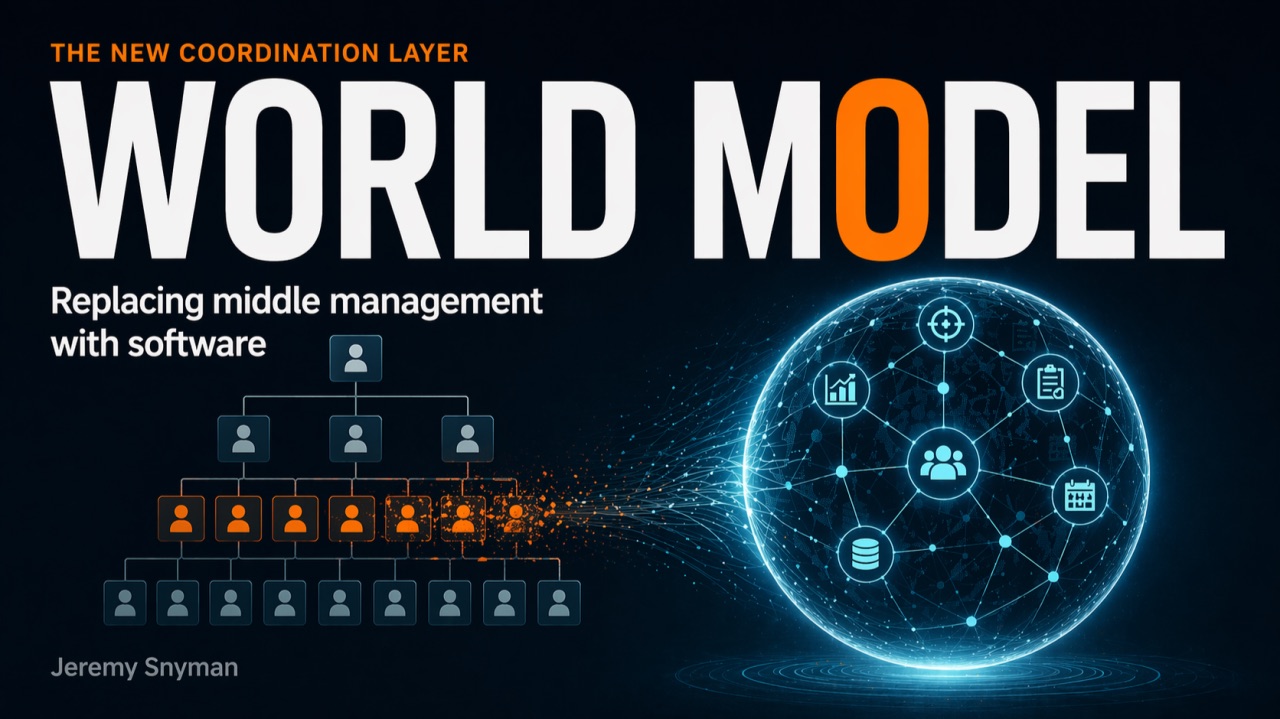
I fully agree with Dorsey that the hierarchy we know today will collapse. I am not sure he has the replacement entirely right. The change is coming either way, because competitors will find speed and scale and new startups will replicate in months what you built over years. The question is not whether the organisation changes. It is how. And the part most of us have not yet counted is the cost of the transitional phase.
Jack Dorsey published a long essay on Block’s website called “From Hierarchy to Intelligence.” His argument starts with a simple object: the world model. In plain terms, a world model is a company’s live picture of itself. What it is doing, who is doing it, what has been committed, what is happening with each customer. In a traditional hierarchy, that picture lives in human heads, and middle managers are its custodians. Dorsey’s claim is that AI can now hold it as a live artefact instead.
He is not writing from theory. Block cut around 4,000 people earlier this year, roughly 40 percent of a workforce of just over 10,000, the majority in coordination and middle-management roles. The essay, co-authored with Roelof Botha of Sequoia, is the public justification several weeks after the fact.
Block is not the only bet on the table. EY announced a global rollout of enterprise-scale agentic AI across 130,000 of its Assurance staff, covering 160,000 audits a year. Block cut the coordination layer in anticipation of the architecture. EY embedded agents into its existing workforce on top of an operating model refined over a century. Two institutional bets on the same shift, made in the same window. The interesting question is which is more honest in twelve months’ time.
The capability layer underneath them moved too. Both OpenAI and Anthropic shipped new generations of their flagship models this week. Stronger reasoning, faster tool use, longer agentic horizons. Anyone designing the new operating model is designing it on a substrate that will keep moving underneath them for the next several years.
The pushback has also arrived. Most of the companies racing to implement Dorsey’s thesis are going to fail silently, and the reason is structural. What most leaders call a world model is, in practice, a vector database. A vector database blurs what you put into it. It compresses high-signal inputs and low-signal noise into the same format, and the retrieval layer cannot tell them apart. Without an interpretive boundary, a term I owe to the AI strategist Nate B Jones, the system cannot tell the difference between a fact it should act on and a hunch it should flag. It fails quietly. You do not notice until a customer complains, a regulator asks a question, or a senior leader catches a decision made on bad signal.
Let me be clear on where I sit. I fully agree with Dorsey that the hierarchy we know today will collapse. Competitors will find ways to speed up, increase effectiveness, and compound impact. New startups will replicate in months what you built over many years. This is not a maybe. So Dorsey’s question is the right one: how does the organisation change, given the change has to come?
Where I am less sure is that Dorsey has the replacement entirely right. Block may be claiming the benefit of AI before the underlying technology has quite matured. We have jumped ahead and assumed AI is already mature when in practice it is still earning that maturity, quarter by quarter.
What Dorsey is actually describing
The Company World Model holds the internal state of the organisation, continuously updated. People, capabilities, commitments, decisions, outcomes. A hierarchy is a human-readable version with a pay structure attached.
The Customer World Model is the same thing, per customer. That state currently lives in senior salespeople and customer success managers.
The Capabilities Layer is the atomic units of what the company can do. For Block, payments, lending, card issuance, payroll, fulfilment. Capabilities are the verbs of the business.
The Intelligence Layer is what Dorsey claims replaces middle management. It composes capabilities on top of the two world models, proactively, without a human telling it what to do.
Three roles survive: individual contributors, directly responsible individuals who own outcomes, and player-coaches who contribute while they mentor. The pure manager, whose entire job is coordinating the work of others, goes away, because the intelligence layer now does that composition.
If the composition layer works, most coordination roles are redundant. If it does not, you have removed around 4,000 human pattern-matchers from an organisation that was relying on them to catch errors.
Why most of these builds will fail silently
The critique is not about the thesis. It is about the implementation. The world model most companies are currently building is not a world model. It is a vector database.
A vector database blurs what you put into it. Inputs are compressed into embeddings. Embeddings are good at proximity and terrible at structure. A high-signal fact and a low-signal aside can sit side by side with no way for the retrieval layer to tell them apart. There is no concept of “is this still true,” “who said this,” or “has this been contested.”
Three failure modes follow. A fidelity ceiling, because the store cannot represent structured relationships cleanly. Missing structure, because information that deserves to be structured stays unstructured. And silent drift, because nothing in the system knows how to compare its state to reality.
The interpretive boundary, in plain engineering terms
How does a company model stay honest over time? How does it know what it knows, what it does not know, and what has changed? How does the thing that replaces the middle layer avoid becoming a confidently wrong oracle?
The answer has four parts. An interpretive boundary is made of them.
A gated lifecycle. Information moves through phases, not a single bucket. Signal enters unstructured. It gets reviewed, provisional, challenged, load-bearing. Each gate has entry and exit criteria. Without gates, everything in the model is at the same confidence level, which means nothing is.
A scoring framework for evidence. A low-impact reversible change passes on thin evidence. A high-impact irreversible one has to show its working. The dimension that matters is impact crossed with reversibility, made legible to a system that is going to do the calibration at scale.
A belief revision mechanism. Champions hold the current view. Challengers bring new evidence. When a challenger wins, the model updates and the change is auditable. When a champion wins, the challenge is recorded and retired. A world model that cannot revise itself in public becomes confidently wrong.
Visible epistemic status. Every piece of information carries a marker of how it was acquired, how contested it is, how recent it is, who owns it. Operators see the confidence behind the answer, not just the answer.
Structure is revealed by outcomes, not prescribed by org charts. Technology opens the space of structures an organisation can sustain. Evidence earns the place a given structure takes. Signal that is repeated, validated, and consequential graduates to structure. Prescribing the whole ontology on day zero produces the kind of rigidity that makes enterprise software famously unusable. Skipping structure entirely produces silent drift. The middle path is graduation.
The human dimension
Block cut around 4,000 people. The bulk of those were coordination roles, which is another way of saying they were the ones holding the company’s world model in their heads. Their skills were not theatre. They were load-bearing.
The muscle memory of a good middle manager, the constant mental calibration of “is this real, is this still true, who owns this, what changed,” is precisely the muscle memory the interpretive boundary needs. The same people who held the world model in their heads are, if the organisation chooses to keep them, the best possible operators of the governance layer that replaces it.
If you cut thousands of pattern-matchers without investing in the machinery that replaces them, you have not built a world model. You have built a liability. You cannot cut the coordination layer before the replacement is ready.
What to do this week
If you are on a board. Ask your CEO and CTO one question. When new information enters our operating system, how does it know whether to trust it? If the answer is “we have an AI tool that reads it,” the interpretive boundary does not exist. What you need to see is a lifecycle, a scoring mechanism, a challenge process, and visible confidence.
If you are on a leadership team. Resist the temptation to copy Dorsey’s cut without copying Dorsey’s architecture. The Block reduction was the result of an architectural change that happened first. If your architecture is still the old one, cutting the coordination layer produces a governance gap, not a world model.
If you are a founder or early-stage CEO. You have the asymmetric opportunity. You are designing an interpretive boundary from day zero, on a model layer that gets more capable every quarter. Decide early what decisions get gates, what evidence bar applies, who challenges what, and how confidence is recorded. It costs nothing on day zero. It costs the company to retrofit it late.
If you are an operator. Start treating your team’s information as provisional. Most of what your team stores has no confidence markers, no owner, no expiry. Ask “how do we know this is still true” on every assumption your team is running on.
If you are an individual contributor. The role that survives is the one that can revise its own beliefs in public without losing face. When you change your mind, say so, and say why. This is the exact skill the new operating layer rewards, and the one the old coordination layer often penalised.
Where this goes next
Next in this series I want to pick up the question of who, or what, actually operates inside a working world model. If this piece defines the architecture, the next one populates it. The agentic workforce, DRIs paired with agents, what it actually looks like to run a team where some members have a pulse and some do not.
Let us talk
I am having these conversations every week with boards, leadership teams, and operators. Most start on “how does our organisational structure need to change?” and land, inside twenty minutes, on the harder one. How does the operating system underneath our work need to change?
If that is the conversation you are in, drop me a message or connect on LinkedIn. The best arguments I get each week are from the people doing the work.
Outcomes reveal structure. Evidence earns it. The interpretive boundary is not a philosophy, it is an engineering object. You cannot cut the coordination layer before the replacement is ready.
First published on LinkedIn, 23 April 2026.