 MindLynx
With All the Noise Around AI News, Hype and Slop, What Is Real.
Between half and three quarters of new content is now AI-generated, and leaders are right not to trust the commentary. How I read the signal through the noise, what is actually real, and where the line should be when using AI to write.
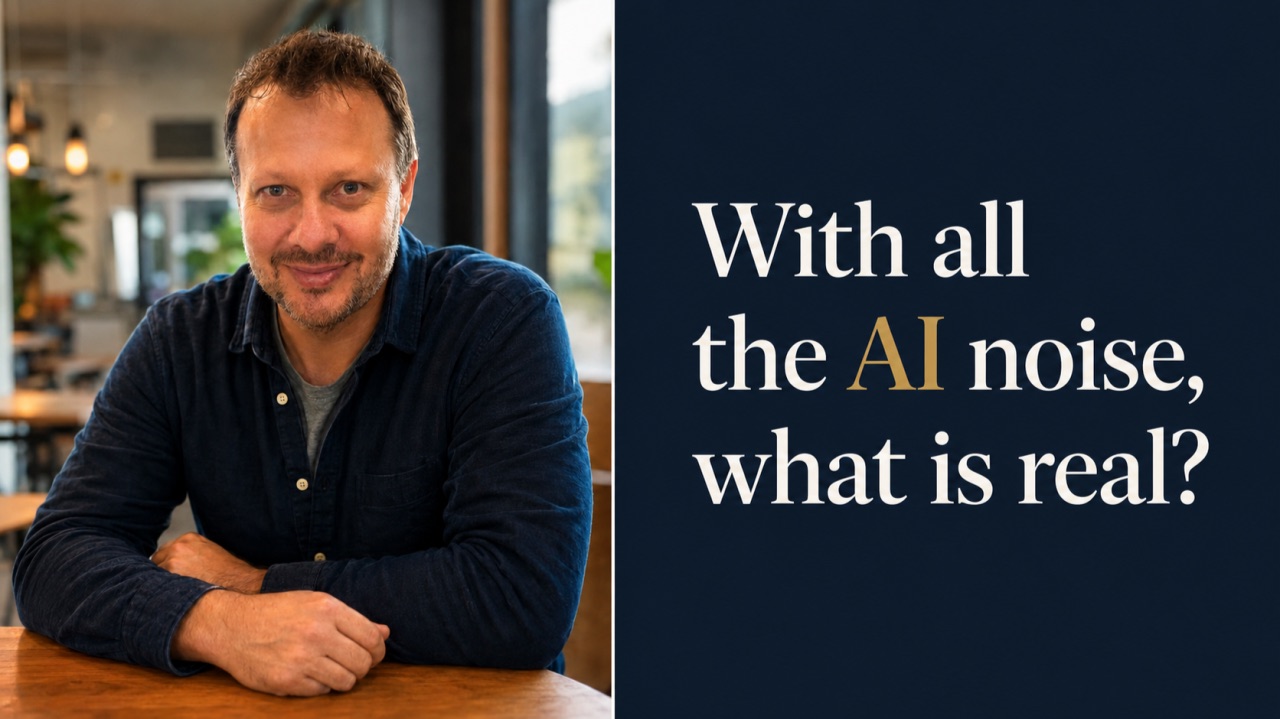
Most of the AI commentary in 2026 is noise. By some measures, between half and three quarters of new content is AI-generated. Both businesses and individuals cannot always tell what is real and are right not to trust all the commentary. This is what I have learned about how to read the signal, and what I think we should actually do about it.
Why I am writing this
I stay on top of AI daily. Not as commentary. As practice. I built a test bed to try frontier models myself. Every week I run the same set of tasks across Claude, GPT, Gemini and a few others, and I watch how they handle them, how they degrade, what they get right and what they hallucinate. I also test the proof-of-concept layer. There are a lot of smart people building genuinely impressive things on top of frontier models. The overwhelming pattern, after months of looking, is that almost none of them are production ready.
The data confirms what I see. RAND’s 2025 analysis put the AI project failure rate at 80%. IDC says 88% of proofs-of-concept fail to transition into production. MIT Sloan’s research on generative AI specifically puts the failure-to-scale rate at 95%. The optimism in the marketing material is not the reality in the deployment.
That gap, between the conversation and the reality, is the thing nobody is naming clearly enough.
A recent Ahrefs study of nearly a million newly created web pages found that 74% of them contained AI-generated content. An MIT and Oxford joint study put 64% of newly published internet material in the same category. Multiple credible sources have new web articles at more than half AI-generated. The internet itself is now mostly noise. The signal-to-noise ratio of AI commentary has collapsed. The boards trying to make real capital allocation decisions on AI are reading a feed that is mostly other AIs talking about AI, repackaged through marketing functions and analyst pipelines that are themselves under pressure to publish.
Most operating leaders cannot tell what is real. They are right not to trust the commentary.
This is the article I have been wanting to write for months. What I have learned, after living inside the noise, about how to read the signal. And what I think we should actually do about what the signal says.
What is real
I trust the income statement. In some countries it is called the profit and loss. I trust the balance sheet. I trust budget reclassifications. I trust what a company is willing to defend to its auditors and its investors, more than I trust what it says in commentary.
As someone who studied accounting, I know books can be cooked. Revenue can be moved across periods to tell a particular narrative. Costs can be reclassified to make a margin look better. None of this is fraud in most cases. It is normal commercial reporting, and it works because most readers take the numbers at face value. So the trust is not absolute. It is comparative. I trust the income statement more than I trust the press release, because the income statement at least has to stand up to scrutiny that the press release does not.
The frame underneath the trust is simple. The priority of any person, or any company, is visible in two places. What they spend their money on, and what they spend their time on. Everyone says they have no money for something, or no time for something. They have both. They have just chosen to allocate the money and the time to something else. The allocation is the priority signal. The statement is not.
Applied to companies on AI, that produces a hierarchy of evidence I actually trust.
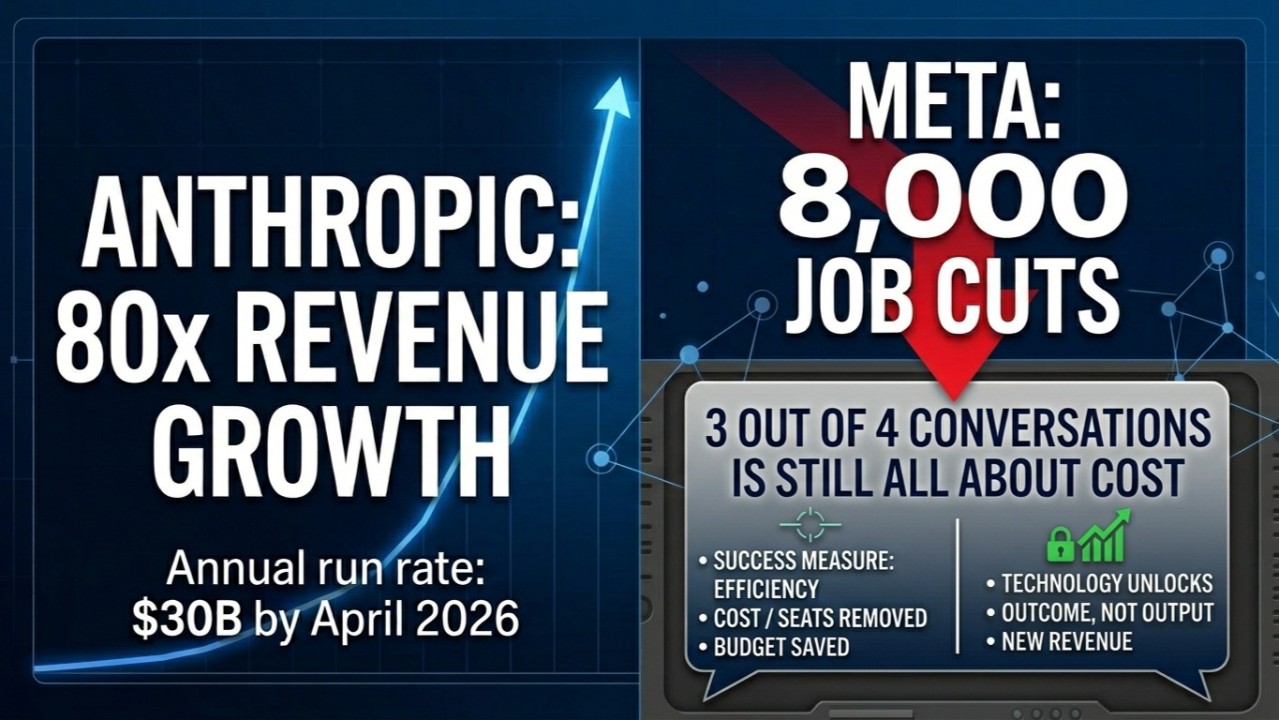
First, the signal in the spend. When Anthropic confirms 80 times year-on-year revenue growth and a 30 billion dollar annual run rate, that is signal because customer budgets are actually moving to pay for it. When Salesforce reports 800 million dollars in booked agent revenue, that is signal because the revenue was paid by real companies that decided this was a priority. When JPMorgan reclassifies AI from R&D to core infrastructure inside a 19.8 billion dollar budget, that is the biggest signal of the three, because reclassifying a budget line is one of the strongest statements a CFO can make about what the firm actually believes. The precise pounds and pence on each of those numbers can be massaged. The pattern of allocation cannot.
Second, the shift across multiple unrelated companies. When SAP, ServiceNow, Microsoft, Salesforce and Workday all rebuild their stacks around agents in the same quarter, that is not coordination. That is five large vendors independently reaching the same conclusion. The underlying force has to be real for that many decisions to converge.
Third, what I see myself. The behaviour of the models inside my own test bed. The conversations I have with leaders and operators across real businesses. The patterns I watch unfold across the companies I follow closely. None of that is rigorous in the academic sense. All of it is direct. I can tell when something I have read in commentary is matched by something I have seen, and I can tell when the commentary is running ahead of the reality.
Fourth, certain people whose knowledge clearly comes from practice rather than theory. I have worked with some of them in the past and I trust their word because I have seen them do the work. Others I watch on YouTube or read carefully online, and the difference between someone who has done the thing and someone who is theorising about it is usually obvious within a few minutes. I do not agree with everything any of them say. Agreement is not the test. The test is whether the person has actually been there and done it, and whether the signs of that are visible in how they describe what they see. In a world of synthetic content, knowing whose word you can trust is itself a discipline. It is one I work at, because it is one of the few ways left to read past the noise.
What I do not trust without triangulation: single surveys, including the Morgan Stanley AlphaWise survey that put UK net AI job losses at 6% over the past 12 months. A commenter pushed back on my post yesterday questioning the survey, and the pushback was fair. The 6% is one input. Probably directionally true. Not necessarily precise. The reason it matters is that it points in a direction many other inputs also point in, not because the precise percentage is the right one.
I do not trust analyst predictions about job displacement at specific percentages. The numbers move every quarter. The direction is the signal, not the figure.
I do not trust vendor case studies without operating-model context. A press release about a deployment that omits the team structure, the supervision layer and the operating-model redesign is marketing, not evidence.
I do not trust Wall Street commentary on AI capability. Hedge fund managers and capital markets voices change their public positions when the trade demands it, not when the truth does. The Ken Griffin pivot earlier this week from “AI is garbage” to “AI is real” is interesting only because it tells us where the institutional money is moving, not because Griffin had a moment of intellectual conversion.
What the signal actually says
When I triangulate across the sources I do trust, the pattern is consistent. Knowledge work is being reduced first. Then execution. Then operations and management.
This is happening across every function I can see. Finance. Customer service. Operations. Product. Software engineering. Data analytics. I hate to write that, because I know the reader hits their own function in that list and feels the weight of it. But it is real. The Morgan Stanley AlphaWise 6% number is directionally correct even if the precise percentage is not. The UK is running this experiment harder than other major economies. The ONS data confirms it from a different angle. The Bank of England Governor has compared the scale of displacement to the Industrial Revolution and specifically flagged junior roles in law, accountancy and administration.
Anthropic’s CEO Dario Amodei warned in May 2025 that AI could eliminate up to half of entry-level white-collar jobs and push US unemployment to 10 to 20% within one to five years. He has softened the framing since, citing Jevons Paradox to argue the effect will be smaller. The interesting thing is not whether he was right at 50% or wrong. It is that the CEO of one of the world’s most prominent AI labs had to publicly walk back a number. The signal is the size of the move, not the precise percentage. Even if it is 20%, that is one in five working-age adults. One in five.
The structural reason this will continue is the part nobody wants to say out loud. Cost reduction is the bottom-line lever boards reach for. It is the easiest answer to defend in a quarterly. The growth side, the revenue side, the new-opportunity side, all of those require redesign and creativity and patience. The cost side requires a spreadsheet. Until AI is treated by boards as a vehicle for growth and creativity, not just cost and efficiency, the headcount outcome will keep getting chosen.
And businesses are using AI as the excuse for the cut, in many cases. The data supports this. A December 2025 survey of 1,000 hiring managers found that 59% admit they emphasise AI in layoff announcements because it “plays better with stakeholders” than admitting financial constraints. Gartner found that companies reporting strong ROI from AI automation laid off workers at the same pace as companies reporting weak or negative ROI. The layoffs are decoupled from the gains. Harvard Business Review published a piece in January 2026 titled “Companies Are Laying Off Workers Because of AI’s Potential, Not Its Performance.” Lisa Simon, chief economist at Revelio Labs, has said it on the record: “AI is a little bit of a front and an excuse.”
That is also signal. Even if every AI productivity claim is overstated by half, the layoffs are still real, the headcount is still going down, and the businesses making those cuts are now publicly committed to AI productivity gains they may not be able to deliver. The unwinding of that, when it comes, will be its own story.
The bit that worries me most
The youngest and most inexperienced are paying the highest price. The under-35 cohort in the UK is down 296,000 since October 2024 against a rise of 18,000 for older workers. Youth unemployment is at 16.2%. The graduate market is the toughest most people have ever seen.
The reason this worries me is structural. Junior work is laborious tasks. The first-year analyst’s earnings model. The junior associate’s document review. The new graduate developer’s pull request. Those are bounded, structured, pattern-rich tasks, which makes them the work AI is most spectacularly good at. So companies are taking that work and giving it to AI.
What we are doing, when we do that, is eating the training ground that produces the next generation of operators. The first-year analyst learns the business by building the earnings model. The junior associate learns the law by reviewing the documents. The graduate developer learns the codebase by writing the pull requests. The laborious tasks are not a tax on the business. They are the apprenticeship. We are letting AI do the apprenticeship and pretending we do not need it.
In ten years, when we need a generation of operators who actually understand how the work fits together, we will not have them. The training ground will have been hollowed out. And the people running AI then will not know what good looks like, because they will not have had to do the laborious version of the work first. My biggest concern about the current trajectory is not the displacement itself. It is what gets lost in the displacement. Domain knowledge, judgment, the instinct for when something is right and when something is off. None of that comes from operating AI. All of it comes from doing the work the AI is now taking.
What to do about it
Five lanes. The first is the one I think nobody should choose, and I will say so directly.
The first lane is to do nothing. Wait for clarity. Wait for the dust to settle. Wait until the technology matures. This is the most popular lane and the one I most strongly disagree with. If this is as existential a shift as the Industrial Revolution, and there is mounting evidence that it is, waiting is the worst choice you can make. Waiting puts your future in the hands of companies that will choose cost over you, every time, when the choice presents itself. They will not do the right thing by default, because the bottom line is the most important thing inside most businesses and we should not pretend otherwise.
The second lane is to take your domain knowledge and use it inside your current business. Find out how AI can make you more efficient. Find new opportunities AI unlocks for the business. Share them with your leadership. Increase your value as a human inside the business. This sounds strange, because businesses should already see your value. But that is not always the case. The bottom line is what matters at the top. If you can show, concretely, that your domain knowledge plus AI is producing more value than your domain knowledge alone, you become harder to remove.
The third lane is to start your own business. I believe more businesses will be started by people with deep domain knowledge over the next five years than at any time in living memory. The reason is structural. The coordination cost and the execution cost have collapsed. A person with domain knowledge, motivation and belief can now build something that would have required a team of fifteen in 2022. That is the system I am building right now. Tools that let people with knowledge become operators, without needing the traditional infrastructure that used to gate the door.
The fourth lane is a side shift inside your career towards judgment work. Quality control. Editorial judgment. Determining what should be built. Deciding when something is good enough. The pipeline from idea to execution has a lot of human in the loop, and the humans in the loop need to know what they are looking at. If you can shift towards that work, you stay valuable. My concern is that businesses cutting knowledge workers are also cutting the humans in the loop, because they do not yet realise how much of the AI workflow depends on them. That is the wrong cut. If you can position yourself as the human in the loop who actually knows what good looks like, you have a longer runway than the people doing the work AI is now taking.
The fifth lane is to shift careers entirely. Look around. Do not wait. Even while you are still in your current role, start doing something on the side. Build the next thing while the current thing is still paying. Easy to say, hard to do, but the people who do it now have a runway. The people who wait until they have to do it will not have one.
The thing that becomes scarce
In a world where most content on the internet is AI-generated and most commentary is noise, the commodity that becomes scarce is authenticity and trust. Real opinions from real people who have done the work and have something at stake. That is what audiences will pay for, follow, and listen to. It is also what I am trying to build inside this writing.
The ROI on AI is still mostly perception. The companies claiming productivity gains are mostly working from pilots that the data says will not scale. Predictability is still a novelty inside AI systems. We are at the start of the journey from probabilistic to deterministic, not the end of it. The systems I am building inside my own work treat AI as a participant in the workflow, not the whole workflow. That is the shape I think production-ready AI looks like over the next two years. AI in the loop, humans in the loop, both clearly defined, neither dominant.
How I use AI to write this, and where the line should be
I should be transparent about how this article was written, because the wider argument depends on it. I use AI to help me craft these pieces. The voice is mine. The sentiment is mine. The hours of dictation, refinement and direction are mine. The AI helps me get from messy thinking to articulated thinking faster than I could alone. That is the appropriate use of the tool inside my workflow.
Where I draw the line, and where I think other businesses should draw it, is at the message itself. Automating the workflow is fine. Automating the message is not. Marketing campaigns are now going out, regularly, where the content is AI-generated, the imagery is AI-generated, the targeting is AI-generated, and no human reviewed whether the message is actually what the company wanted to say. That is dangerous, because the company is publishing things it has not actually decided to publish. The reader receives a message that nobody chose to send. Trust collapses when the audience cannot tell whether what they are reading came from a person making a considered choice or from a workflow that nobody is supervising.
This matters more than it sounds. As more of the commercial content on the internet becomes synthetic and unsupervised, the readers who used to give companies the benefit of the doubt will stop doing so. The companies that survive will be the ones whose messages a reader can trust came from a real decision. Authenticity is not a marketing posture. It is the practical demonstration that a human is still accountable for what is being said.
This is the version of the line I hold for my own writing. AI in the workflow, human at the message. I want to know that when a company speaks to me, a person there decided to say it. I am asking the same of myself here.
A different version of the world that could exist
There is a piece of writing circulating right now that argues all software is being rebuilt for agents, not humans. I do not entirely agree. I think it is both. Some software will be rebuilt for agents because that is the right shape for the work. Some will be rebuilt for humans because the human needs different surfaces. New interfaces are emerging that we have not seen before, where agents and humans both have first-class roles. The two sit alongside each other. Agents will not eat the human interface. The promise, if we build this well, is that they will eat the noise.
Here is the version of the world I find myself dreaming about, and I will call myself naive for saying it, because it probably will not unfold this way. As more of the digital world becomes synthetic, the scarce thing flips. Authenticity becomes more valuable, not less. Real relationships. Real conversations. Real experiences. Real human creativity. We might end up spending more time in the real world, not less. More trips, more in-person time, more of the physical world, because the digital saturation makes the physical relatively richer. Our digital lives and the coordination of our real lives become assisted by agents, while the lived life itself becomes more human, more present, more textured.
I am not promising any of that. I am someone who tries to look for both the good and the bad in any situation, and to find what can be learned from it. I will not claim every shift has a positive version. What I can say is that the response to the noise problem is not to add more noise, and the response to the scarcity of authenticity is not to outsource our authenticity to an agent. The opportunity, if there is one, is to do less of the digital busywork ourselves, and to spend the time saved on the parts of life that matter.
That is also why I think the lanes I described earlier matter. Each of them, in different ways, is a way to take back some of the time and judgment that the noise threatens to absorb.
A request, and a plea
If this resonates, stay close. Follow me here on LinkedIn. Connect. DM me. I am going to keep writing about what is real underneath the noise. I cannot promise to cover every story. I can promise to write only about the ones I have actually triangulated against multiple sources and tested where I can in my own work.
And I want to ask, please, do not write off every headline as self-serving. When Anthropic publishes a 30 to 50% entry-level white-collar displacement forecast, the forecast is probably self-serving, the way every vendor forecast is. But the signal underneath it is real. If the number is 30%, it is catastrophic. If the number is 20%, it is still one in five working adults without a knowledge-economy job. That is a welfare problem on a scale we have not had to think about in a generation. People have to eat. They have to live. Families depend on this.
My plea is that we do not just wait for the problem to suddenly appear, or for things to just happen to us. That we are proactive. Preparing. Positioning. Posturing at times, where that is what helps. Because it might just be that our lives, and the lives of the people who depend on us, are at stake here.
The signal is real. The noise is also real. Learning to read one through the other is the work. And if we get this right, the version of the world on the other side has more humans in it, more real life in it, more of the things that the digital noise has been crowding out. That is the version I am working towards. Naive or not, it is the version worth aiming at.
First published on LinkedIn, 21 May 2026.