 MindLynx
The Autonomous Workforce Is Already Here. This Is What You Need to Know.
ServiceNow named them. Salesforce is building for them. Agents are already part of the workforce, and most organisations still treat them as a tool. The accountability gap, why agent confidence is not accuracy, and the agent manager role.

Collaboration is one of the most overused and undervalued words in business. Not the structured kind: the meeting, the agenda, the action items. The other kind. The conversation between meetings. The idea bounced off a colleague in the corridor. The moment someone says something that shifts how you see a problem. Those moments are where a lot of the real thinking happens, and most organisations have no idea how to protect them.
For the past week and a half I have been thinking about this differently, because I have been building a workforce. Not deploying a tool. Not configuring a service. Building colleagues. Each one has a name and a persona. A defined set of expertise: four or five skills, no more, because focus is what makes them trustworthy. A tone and a voice that fits the context they work in. They learn. They remember. You can converse with them in real time, in the same way you would a colleague who happens to know exactly what you need. And when their role is no longer needed, you retire them. You do not cancel a subscription.
That shift in language is not cosmetic. It reflects something real about what these systems are and how they need to be managed.
And here is the part most people have not caught up with yet. When an agent joins your workforce, it does not just do tasks. It uses your systems. It logs into your applications the way any employee does, with its own credentials, its own role-based access control, its own defined permissions. It is not a tool sitting on top of your stack. It is a user inside it. The platforms your business runs on, Salesforce, ServiceNow, Workday, are being rebuilt on the assumption that a significant proportion of their users will not be human. The agent has a defined set of expertise, four or five domains at most, because scope is what makes it trustworthy. It has a degree of autonomy that you set. It operates within those boundaries, and when something takes it outside them, it escalates. That is not software behaviour. That is workforce behaviour.
Salesforce has started saying something that most people are not ready to hear: they are building systems where the primary users are other agents, not humans. The end user of the next generation of enterprise software may not be a person. That is not a distant prediction. It is a design direction they are committing to now. I do not think it goes all the way there. People remain in the loop for judgment, for accountability, for the things that genuinely require human authority. But the direction is set. The systems your business runs on today are being rebuilt around an agent layer. The question is not whether you will have an autonomous workforce. The question is whether you understand what you are dealing with when you do.
ServiceNow named it. They launched what they are calling an Autonomous Workforce. Not an AI feature, not an AI tool. A workforce. With named job titles attached to each agent: L1 Service Desk AI Specialist. Employee Service Agent. Security Operations Analyst. When you buy the platform, you are not buying software you deploy. You are hiring, in the language ServiceNow is now using, a team member with a defined role and a scope of authority.
The L1 Service Desk AI Specialist, in controlled availability now, resolves IT cases 99% faster than human agents. ServiceNow’s EmployeeWorks product gives access to this agent workforce to nearly 200 million employees across enterprise customers worldwide.
In the same week, Salesforce confirmed that Zach Stauber’s job title is Support Agent Manager. He does not manage human support agents. He manages a fleet of AI agents running across support, sales, and marketing. His day involves checking agent performance metrics, reviewing escalated cases, identifying where agents are failing, adjusting parameters, and reporting outcomes to the business. That is a management job. It just does not involve anyone who goes home in the evening.
Workday has rebuilt its interface around an agent layer. Gartner projects that 40% of enterprise applications will embed AI agents by the end of this year, up from less than 5% in 2025. CHROs report that 80% of their peers project most workforces will involve humans and agents working together within five years.
The autonomous workforce is not a prediction. It is the current state of the most advanced organisations in the world, and it is arriving fast enough that most organisations will find themselves inside it before they have built anything to manage it.
That is the problem I want to write about this week. Not whether the autonomous workforce is coming. That question is settled. The question is whether anyone knows how to run one.
Where we are in the series
This is part of an ongoing series, and the argument has been building for some time. I started with the economics: AI-native companies generating revenue-per-employee multiples that make traditional SaaS look like a different industry. Then the operating model: the technology does not deliver until the way of working changes. Then the org structure: smaller, flatter, autonomous units built for speed rather than coordination. Then judgment: the one skill that survives when execution cost drops to near zero. Then the compounding gap: why the distance between leaders and laggards widens at an accelerating rate, not a linear one.
Two articles ago, I described the architecture that replaces the org chart: the world model, the interpretive boundary, the earned structure principle. Last week I went personal: who the old system was built for, who it was quietly losing, and why AI is rebalancing access in ways the conformist corporate ladder never could.
This week is where both threads land. The architecture is changing. The people inside it are changing. And now the composition of the team itself is changing. Some of your teammates, possibly most of them in certain functions within a few years, will not have a pulse. The question is what that actually requires of the ones who do.
The moment the language changed
It matters that ServiceNow chose the word “workforce” and not “toolset.” It matters that they issued job titles. And it matters that Harvard Business Review published a piece arguing that companies now need a new role, the agent manager, in the same month that Salesforce’s Zach Stauber became the first person most people had ever heard of who actually holds that title.
Language is not decorative in enterprise technology. When vendors change the language, they are changing the accountability frame. A tool malfunctions. A workforce member fails. The difference is not semantic. When you deploy a tool, the liability for its outputs is distributed and diffuse. When you hire a workforce member, even a silicon one, the expectation of oversight, governance, and accountability is specific. Someone is responsible. Someone should have caught it. Someone needs to answer for it.
Most organisations buying agentic AI in 2026 are treating it as a tool. The vendors are beginning to insist it is a workforce member. The gap between those two framings is where most of the governance failures of the next three years will be incubated.
Three things most organisations are not doing
The data on hybrid team deployment is striking not for the adoption numbers but for what the adopters are skipping.
Gartner projects that 40% of enterprise applications will embed AI agents by the end of 2026, up from less than 5% in 2025. Yet only 29% of organisations report significant ROI from generative AI, and only 23% from agents specifically. 54% of C-suite executives say AI adoption is “tearing their company apart.” The deployment happened. The management model did not.
Only 23% of companies have scaled even a single agent system beyond a pilot into a real business function. Of those, most have not built a supervision layer. They have pointed the agent at a workflow, connected it to the data, and left its outputs for someone downstream to catch. That someone is usually the customer.
Harvard Business Review published a piece in March this year titled “Create an Onboarding Plan for AI Agents.” The premise is simple and almost universally ignored: agents, like new hires, need context, defined constraints, escalation paths, and feedback loops to perform well. Without those, the agent optimises for what the system rewards, which is almost never the same as what the organisation actually needs. A new human hire who received no onboarding, no clarity on their scope, and no feedback mechanism would perform poorly and be difficult to course-correct. The same is true of an agent, with one important difference: the agent scales its errors much faster than a human does.
The three things most organisations are failing to do are these.
First: onboarding agents as if they are team members rather than software releases. Defining what the agent knows, what it does not know, what it should escalate, what constitutes a good outcome, and how it should behave at the edge cases that were never specified. This is not a one-time configuration. It is an ongoing management practice.
Second: building the management layer before the agent layer outgrows it. The common failure pattern is sequential: deploy the agents, watch them scale, realise nobody is actually supervising them, try to retrofit governance. By that point the habits are set. The agents are running unsupervised at volume. The governance is theatre.
Third: defining, in writing and in advance, what the agent owns outright, what it recommends and a human decides, and what it flags and a human investigates. I have called these the three boundaries, and in all the conversations I have had with leadership teams this year, almost none of them have a written version. They have a vague sense that humans are “in the loop.” What that means in practice is almost never specified.
The accountability gap is open in most organisations right now
Here is the governance problem at the centre of the hybrid team, and it is not abstract.
When an agent makes a recommendation and a human acts on it, who is accountable for the outcome? When an agent escalates a case and the human overrides it, what happens to the agent’s model? When the agent is wrong and nobody caught it, who is responsible for not catching it?
These questions do not have agreed answers inside most organisations today. They are being answered by accident, case by case, and usually after something goes wrong. The answers being made by accident will be held against the people who made them. The board will want to know who was accountable. The regulator will want to know who approved it. The customer will want to know who decided.
The leadership team that has not defined the accountability structure for its agent fleet is not running a governance-light organisation. It is running one where the governance gap is open and widening, and where the first serious incident will determine who gets blamed for not closing it.
Agent confidence is not agent accuracy
Agents in 2026 are confident. They respond quickly, fluently, and with apparent authority. They do not hesitate. They do not caveat as often as they should. They do not say “I am not sure about this one.” They produce an answer at the speed and tone of certainty, and that tone of certainty is what makes them feel useful. It is also what makes them dangerous when they are wrong.
In structured, high-volume, well-defined workflows, agent confidence correlates reasonably well with accuracy. The L1 Service Desk agent resolving a password reset request is operating in a domain where the answer is either right or wrong, the feedback loop is tight, and errors are immediately visible. The 99% speed improvement cited by ServiceNow is real and the accuracy holds because the scope is constrained.
In ambiguous, judgment-heavy, high-stakes workflows, the correlation breaks down. The agent sounds equally confident whether it is solving a simple routing problem or making a recommendation that will shape a strategic decision. The human reading the output has no signal to distinguish between the two cases. The agent’s tone does not change with its uncertainty.
Research presented at ICLR 2026 put numbers on this. The paper, “The Reasoning Trap,” demonstrated that reinforcement-learning training designed to improve agent reasoning increases tool-hallucination rates in lockstep with capability gains. The more capable the agent becomes, the more it confidently invents tool calls it cannot actually make or references steps it cannot complete. Capability and reliability are now empirically dissociated. Upgrading the model does not automatically mean you have upgraded its trustworthiness. That is not an edge case. It is a structural feature of how these systems are trained.
The early evidence from organisations that have deployed agents into ambiguous workflows bears this out. The ratio of effective agents to human oversight that works in a structured workflow collapses badly when applied to strategic work. One agent manager can effectively oversee 15 to 30 agents in a high-volume structured function. In ambiguous, judgment-heavy work, that ratio drops sharply. The agent needs much more human review precisely in the situations where the review is most cognitively demanding and therefore most likely to be skipped.
The mistake almost every organisation I speak to is making is applying the high-volume ratio to ambiguous work because the agent looks confident doing it. Do not mistake the agent’s confidence for the agent’s accuracy. They are not the same thing, and the gap between them is where the serious failures will happen.
The human in the loop has become a rubber stamp
Many organisations have a “human in the loop” requirement. Before an agent’s output executes in the world, a human must approve it. This sounds like governance. In most cases it is not.
In practice: the volume of agent outputs requiring approval quickly exceeds the capacity of the human reviewers to read them meaningfully. The pressure to process is high. The time available is low. The human clicks approve on 98% of cases without genuine review because the alternative is a backlog that stops the function from operating. The human in the loop has become a rubber stamp. The liability has not gone away. It has been laundered through a human click that was never meaningful oversight.
This matters legally, operationally, and culturally. Legally, because the click creates a paper trail that implies review without the substance of it. Operationally, because errors that would have been caught by genuine review accumulate until they compound into something visible. Culturally, because the humans doing the rubber-stamping know they are not really reviewing, and that knowledge erodes their sense of accountability for the outcomes in ways that are hard to reverse.
The fix is not more humans in the loop. It is better-designed loops. The human review point should be calibrated to the cases where human judgment actually changes the outcome, not distributed uniformly across all outputs. The cases that are genuinely ambiguous, high-stakes, or irreversible should have real human review. The cases that are structured, low-stakes, and reversible should execute with post-hoc audit rather than prior approval. Most organisations have the ratio backwards.
The agent manager: a real role that most companies are staffing badly
HBR’s argument is worth taking seriously. Just as product managers emerged during the software revolution to bridge the gap between what was technically possible and what the business needed, agent managers are the role that bridges the gap between what agents can do and what the organisation actually needs them to do.
The role is not IT administration. It is not data science. It sits between corporate strategy and the AI systems executing it. It is accountable for outcomes, not just for uptime.
The key finding from the HBR research: domain expertise matters more than AI expertise for agent managers. The best practitioners come from the function being automated. A former tier-1 support analyst who transitions into managing the support agent fleet will outperform a data scientist who has never worked in support. The reason is simple. Managing an agent well requires knowing what good looks like. You cannot catch the agent’s errors if you do not know what the correct answer is. You cannot define the escalation criteria if you do not know what makes a case genuinely hard. You cannot improve the agent’s parameters if you do not understand the customer’s experience of the failure.
This connects back to the skills argument I have made across this series. Judgment is the surviving skill when execution cost drops to near zero. The agent manager role is domain judgment applied to a non-human team. The interface has changed. The underlying capability has not.
It also connects to the generalist argument from Article 6. The agent manager is the generalist of the hybrid team. They do not build the agents. They do not maintain the infrastructure. They understand the domain, they understand the outcomes the business needs, and they operate at the boundary between the agent layer and the world. That boundary is exactly where the interpretive boundary in the world model lives. Same person, different context.
What this does to the humans on the team
I operate with two lenses, and I always have. One is the efficiency lens: how do we do more for less, how do we reduce the cost between idea and outcome, how do we unlock the capacity that coordination overhead has been absorbing for years. The other is the people lens: what does it mean for someone to feel that their work matters, that they are growing, that they are contributing something that could not simply be done without them.
I have been in enough board conversations over the past two years to know the efficiency argument is real and it is urgent. Most companies are being squeezed right now, not always on revenue, but on profit. And the cost of coordination has become genuinely untenable. The layer between idea and result has ballooned in ways that are hard to defend when execution is suddenly so much cheaper. That layer has to shrink. I do not think there is an honest argument against that.
But here is where I land, and it is where I always land: the answer is not to keep the same number of ideas and deliver them faster. The answer is to run more of them. Not more people in each flow from idea to outcome, but more flows. Each pipeline leaner, faster, with fewer people between conception and result. The reduction in execution cost does not just make existing things cheaper. It makes previously impossible things viable. More experiments. More attempts. More shots at problems that were too expensive to try before. The opportunity is not to shrink the organisation. It is to grow the ambition of what the organisation attempts.
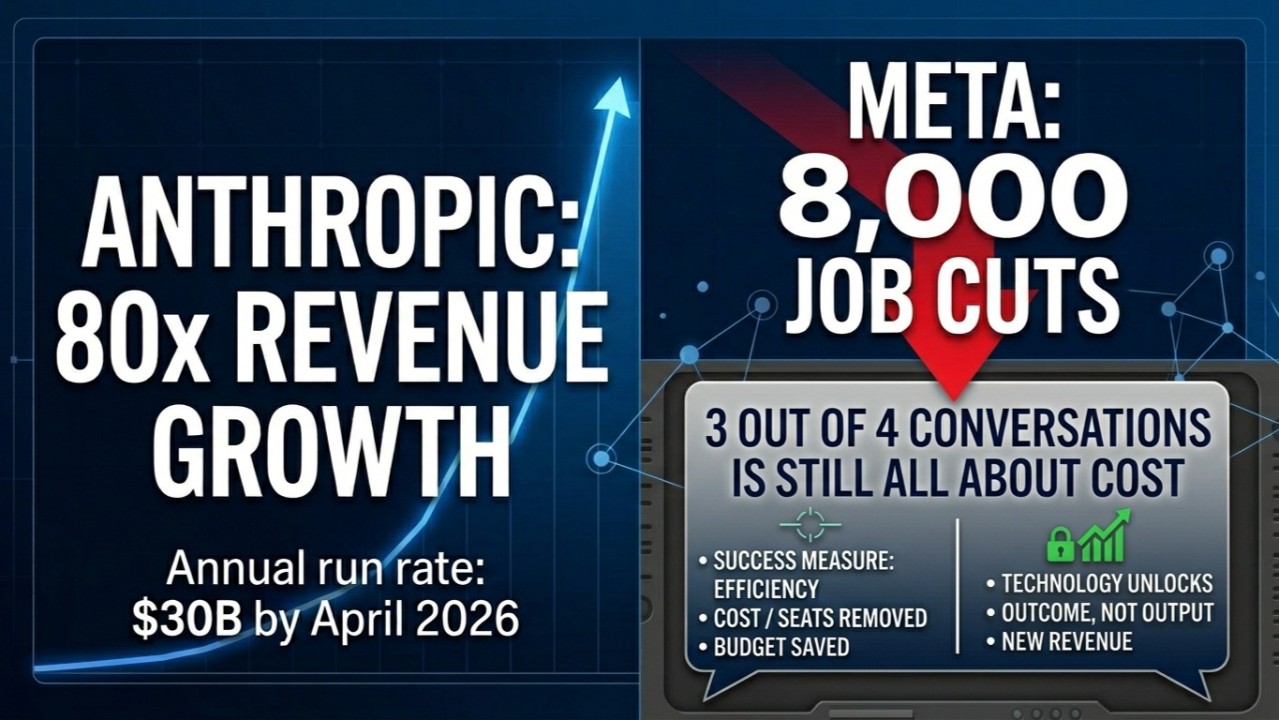
I have heard too many people say with confidence that AI will not take jobs. I hope they are right. But I have also sat in enough boardrooms to know that cost reduction is a real driver right now, and that the headlines about tens of thousands of redundancies at major companies are not fabricated. The coordination layer is being cut. That is happening. The question for every leader is what they put in its place, and whether the people affected are left behind or repositioned.
And here is the question I think everyone needs to sit with, individually, before they can answer it for their team. Look honestly at your job today. What percentage of it could be automated or augmented by an agent? And then ask: what do you do with the time and attention that frees up? Because that answer is your leverage point. The cost of experimentation just dropped. The cost of building just dropped. The cost of trying something new just dropped. If your answer to that question is “I do not know,” that is the work.
Which brings me to the four skills I think matter in this transitional phase. Not skills for a distant future. Skills that are buildable now, that compound over the next two to three years, and that position people for whichever version of the AI-shaped economy we end up in.
Judgment over execution. When the cost of execution drops to near zero, the ability to decide what to build, what to stop, and what the output actually means becomes the scarce resource. Agents execute well. They do not decide well. The person who can sit with ambiguous information, weigh competing signals, and make a consequential call, including calling a halt when the agent is confidently wrong, is the person the hybrid team is built around. This is not a new skill. It is a skill the old system undervalued because execution was expensive enough that doing it fast mattered more than doing it right.
Deep domain, not broad familiarity. The people who will manage agents most effectively are not the ones who know the most about AI. They are the ones who know their domain well enough to catch what the agent misses. You cannot audit what you cannot evaluate. You cannot define quality if you have never done the work. The value of domain depth is increasing, not decreasing, because the agent produces volume and it takes genuine expertise to know which of that volume is wrong. Broad familiarity is now the agent’s territory. Deep understanding is still yours.
Learning at the pace of change. The models are updating quarterly. The tools are updating faster. The mental models that were accurate six months ago are already partially obsolete. The skill is not knowing the current state of AI, it is being able to rebuild your picture of it continuously, without ego, without holding on to what you understood last year because it was useful then. This is not about keeping up with LinkedIn posts. It is about treating your own assumptions as provisional and updating them as the evidence changes. People who do this well will be trusted to lead in this environment. People who do not will be increasingly confident about things that are no longer true.
Honest self-inventory. The hardest one, and the most important. It requires looking at your own work and asking which parts of it are now commodity execution that an agent does better, faster, and more consistently than you do. Not as a threat. As a map. The parts of your work that survive that inventory are the parts worth doubling down on. The parts that do not survive it are the parts where your energy is better spent elsewhere, on the new ideas, the new experiments, the things that the reduction in execution cost has just made newly possible. Most people avoid this question. The ones who engage with it are the ones building the most durable positions right now.
What the three boundaries look like in practice
I said earlier that organisations need to define what agents own, what they recommend, and what they flag. Let me be more concrete about what that looks like.
What the agent owns outright: fully structured, well-defined tasks with a clear correct answer and a tight feedback loop. Password resets. Invoice matching. Appointment scheduling. Routine data retrieval. The agent executes, the result is either right or wrong, and the error is immediately visible if it is wrong. Human oversight is post-hoc audit rather than prior approval.
What the agent recommends and a human decides: tasks where the correct answer depends on context the agent may not fully have, or where the consequences of being wrong are significant enough to warrant human review. A loan approval recommendation. A customer churn risk flag. A content moderation borderline case. The agent does the analysis and presents the recommendation. A human with domain expertise reviews and decides. The human’s decision is the binding one.
What the agent flags and a human investigates: situations the agent recognises as outside its scope, or where confidence is below a calibrated threshold, or where the stakes are high enough that no agent decision should proceed without human investigation. Potential fraud. Regulatory edge cases. Escalated complaints from high-value customers. The agent identifies the situation and routes it. The human takes ownership.
These three categories are not permanent. They shift as the agent earns trust, case by case, with an auditable record. An agent that has been consistently accurate in a given category of recommendation for six months, with zero errors that a human would have caught, can have that category moved from “recommend” to “own.” That is the earned structure principle again, applied at the team level rather than the model level. Trust accretes from outcomes. It is not granted in advance.
What to do this week
One action per kind of reader. Take the one for your role.
If you are on a board. Ask your CEO this question directly: for every agent we have deployed, who is the named human accountable for its outputs? Not which team. Which person. If the answer is unclear or inconsistent, the governance gap is already open. The first serious incident will close it for you, in a way you will not enjoy. Close it now.
If you are on a leadership team. Before you deploy the next agent, define the three boundaries in writing. What it owns. What it recommends. What it flags. The document does not need to be long. It needs to exist and to be reviewed in 90 days. If you cannot write the boundaries before deployment, you are not ready to deploy.
If you are a founder or early-stage CEO. You are building the hybrid team from scratch, which is the structural advantage. The mistake to avoid is treating agents as infrastructure. They are workforce. Define the management layer before the agent fleet outgrows anyone’s ability to oversee it. Hire or develop agent manager capability early, and recruit it from the domain, not from the data team.
If you are an operator. Identify one workflow in your function where an agent is operating without a named human owner. Assign one. That person’s job is not to do the work the agent is doing. It is to know what the agent is doing, catch what it misses, and escalate what it should not decide alone. Start with one. The habit compounds.
If you are an individual contributor. If your team is deploying agents, volunteer for the oversight role. Not to protect your job. Because the people who develop the judgment to manage agents over the next two years will be among the most valuable contributors in any organisation after that. The execution is going to agents. The judgment stays with you. Build the judgment deliberately, and build it now.
Where this goes next
I have been teasing, across the last two pieces, an idea about a personal operating system built around the way thinking actually happens rather than the way org charts have always assumed it does. It includes cognitive diversity by design. It treats memory as a substrate for growth rather than a cabinet of facts. And it is built for the kind of work the hybrid team requires: judgment, not execution; synthesis, not production.
That is one direction for the next piece. The other is to go function by function and describe what the hybrid team actually looks like inside a specific part of the business. Finance, sales, customer success, engineering. The structural argument is clear enough at this point that the more useful question may be: what does this look like for someone in my function, managing my team, with my budget?
The response to this piece will tell me which one you need more. Either way, the next few articles are going to get considerably more practical, because the structural argument has been made. The work now is working out what to do with it.
If you are navigating this, whether at the board level, the leadership team level, or on the floor, I want to hear from you. Connect on LinkedIn. The best arguments I get each week are from the people doing the work, not reading about it.