 MindLynx
We Built Companies for the Conformist Mind. AI Is About to Break That.
A more personal piece. Cognitive range is a strategic capability, and the org chart, the meeting cadence and the career ladder were designed against it. What AI changes for minds that work differently, and what leaders should be asking.
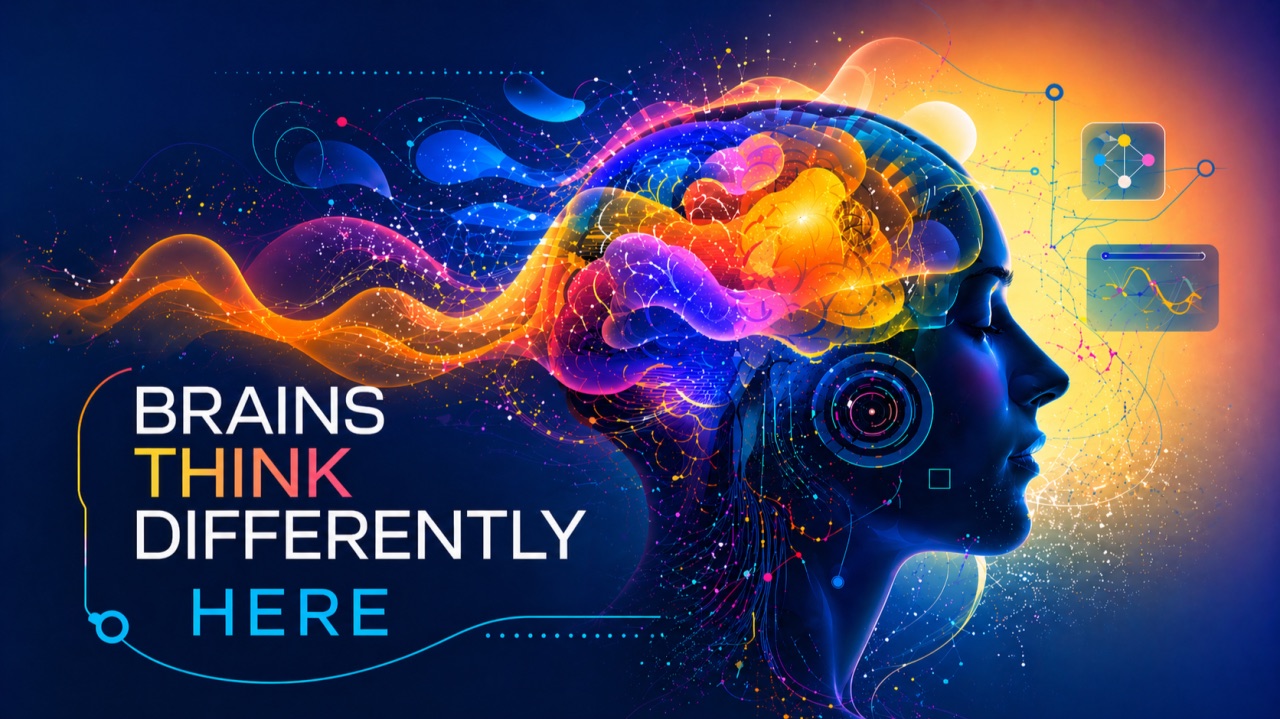
Cognitive range is a strategic capability. The org chart, the meeting cadence and the career ladder were all designed against it. AI is about to make that expensive.
I do not usually write about myself in this series. Most of what I have published has been structural. Economics, operating models, the new shape of organisations, the skills that survive the restructure, the compounding gap between companies that have moved and the ones still running pilots. This week is different, and I want to flag that up front.
I have spent the last eighteen months working with AI almost every day, and somewhere in that process I started to see my own mind, and how I actually work. Not in a self-help way. More like the slow dawning realisation that the way I think has always been a particular shape, and that for most of my career I have been trying to fit that shape into systems built for a different one.
This piece is part of an ongoing series, and it asks a question I have not asked yet. When the org chart is rewritten and the executional layer collapses, who actually thrives in the shape that comes next? And, more uncomfortably, who has the system been quietly losing all along?
Managing a wider range of minds is a craft
I have worked with many different kinds of leader over my career. They have not fitted neatly into two camps, but the patterns I have learned the most from sit at the edges of the spectrum.
I had a CEO for many years who recognised the way my mind works and built a kind of safe space around it. He did not flatten the parts of me that were unconventional. He gave me unusual problems to solve, asked for the answer, and trusted me to find a route that did not look like anyone else’s route. His line, one I have always subscribed to and have used myself ever since, was simple. Failure is fine. As long as we do not do it twice.
I hope that anyone who has worked for and with me in the past can testify that I have tried to live by that line, not just quote it.
That sentence does more work than it looks like it does. It tells the team that experimentation is welcome. It also tells them that learning is non-negotiable. For a brain like mine, which moves fast and connects things sideways and occasionally drops the ball on something everyone else thought was obvious, that sentence was permission to contribute at full power. It also gave me a clear standard.
What I took from him is that managing a wider range of minds is a craft, not a default skill. Most leaders are promoted up a ladder built for one cognitive shape, and they reach for the tools that served them well at every previous rung. Predictable cadence. Updates that fit the slide template. The same kind of contribution from everyone, just at different scales. That works for plenty of people. It does not work for everyone, and the difference between a leader who notices that and one who does not can quietly decide who in the team gets to contribute at full power and who slowly stops trying.
That is not a personal failing on the part of those leaders. It is a craft most of us were never explicitly taught. The corporate ladder rarely rewards the leader who slows down to learn the operating instructions for an unfamiliar mind. It rewards the leader who keeps the deck on time and the cadence intact.
The largest team I have run was around 120 people, which is not a vast organisation by any measure. The people who carried the most weight were not always the ones who fitted the template. Some of the most valuable contributors I have ever worked with were people I might have lost if I had insisted they look and sound like everyone else. I want that range. I want the diversity of mind, including neurodiversity, because without it you only ever see one part of the picture and you slowly mistake that part for the whole.
ADHD is a misleading name
I am neurodivergent. The way it shows up for me is mostly hyperfocus rather than scattered attention. When something captures my interest, I lock onto it completely. The work, the relationship, the project, the question. Hours pass. Other things fall down the priority list. Then, when the signal weakens, I have to consciously rebuild the discipline to re-engage with everything that should have been getting attention all along.
I used to think that was the opposite of what most people mean when they say ADHD. It is not. It is the same underlying thing wearing a different costume. The shared root is attention regulation. For some people, the brain struggles to lock onto things that are slow, low-reward, or boring. For others, it locks on so hard to the things that feel meaningful that everything else fades.
The label matters less than the recognition. Different brains have different default behaviours, and the modern workplace was largely designed around one of them. Linear, sequential, meeting-driven, predictable, well-suited to people who can apply consistent moderate effort to whatever the system tells them to apply it to.
What AI actually changes
The phrase that captures what AI does for the way my mind works is that it lowers the tax that non-linear thinkers used to pay just to be heard.
If you have ever held an idea in your head that you knew was good, but found that the work of writing it up, formatting it, slotting it into someone’s review template, getting it onto an agenda, surviving the politics, and turning it into a tracked deliverable was so expensive that the idea quietly died, you know exactly what I mean. That tax fell hardest on people whose minds did not produce work in tidy linear shapes.
AI changes that. For some people, it acts as a scaffold. It breaks vague overwhelm into next steps. It remembers context. It produces a first draft when the blank page would have been paralysing. For others, including me, it acts as an amplifier. It lets the non-linear mind move at the speed it actually thinks, without losing the threads. It holds the messy middle. It does not punish the jump from product strategy to architecture to naming to operating model. It can keep up.
For many, it does both.
That distinction matters because it pushes against the lazy version of this argument, the one that says ADHD is now a superpower because of AI. It is not, and that framing irritates me when I see it written by people who have not lived it. Hyperfocus can be brilliance. It can also be 16-hour days that feel like freedom and look like obsession. AI does not fix that.
What AI does change is the interface. And for a lot of people, that is the part that has always been the problem.
The rebalancing, not the reversal
I am not arguing that neurodivergent thinkers are better than neurotypical ones. That would be both untrue and faintly insulting to everyone involved. The teams I have admired most in my career have always been the ones with range. Specialists who go deep. Operators who carry execution. Generalists who connect lanes. You need all of them.
The argument is more specific. For a long time, the corporate ladder has been disproportionately welcoming to one cognitive style and disproportionately costly for several others. People who learned to perform that style well rose. People who could not, did not. Not because they lacked capability. Because the interface was wrong, and the cost of getting their work into the system was too high.
AI is rebalancing that. It is not handing the keys to a new dominant group. It is lowering the cost for several groups that the old system was quietly losing. Domain experts who could not write the code that would have made their insight real. Generalists who could not justify the path that did not fit any single career ladder. Neurodivergent thinkers who could not produce work in the linear shapes the system insisted on. Founders who could not assemble the team they would previously have needed to test their idea.
For all of those people, the path to contribution, to leadership, to ownership, has just got shorter. That is the rebalancing. It does not require anyone else to lose. It requires leaders to recognise that the bench just got wider, and to start picking from it.
The deeper point is that the type of person who can contribute meaningfully at every level of the org chart, contributor, manager, executive, board member, just expanded. The system used to have to work hard to keep them out. Now it has to decide whether to let them in.
The cost is real
I do not want to romanticise any of this.
The same brain that can lock onto a hard problem and stay with it for sixteen hours can also be the brain that struggles to let go. I have taken a laptop on holiday and sat next to a pool with it open, not because anyone asked me to, but because the work felt more alive than the rest of the day. The pressure was not external. It was internal.
Sometimes working through the night does not feel like hard work. It feels like freedom. That is what makes it dangerous. The work is not always a burden. Sometimes it is the place where the mind finally feels quiet.
Hyperfocus is energy without governance. AI can amplify the energy. It does nothing for the governance unless you build that part deliberately.
What leaders should be asking
The question that has dominated the last eighteen months has been: how do I deploy AI to do more with fewer people. That is a real question. It is also a small question. It treats the system as fixed and the people as the variable.
The bigger question is this. What can the people in front of me see that our system cannot? And what would it take to let them say it, build it, lead with it, and own it?
For a long time, leaders have treated cognitive difference as something to accommodate. Sometimes generously. Sometimes reluctantly. But still as a deviation from the norm. That framing was wrong even before AI. It is much more obviously wrong now.
The new framing is harder, and better. Cognitive range is a strategic capability. Leadership is the work of designing systems that let different kinds of minds contribute at full power, including in the seats that decide what the company actually does.
For decades, those minds were often told to adapt to the system. Some of them did, at significant personal cost. Many of them did not, and the system never quite knew what to do with them. AI does not fix the human conditions that come with thinking differently. What it does do is lower the cost of turning unusual cognition into useful output. And that lowering is enough to change who can lead, who can build, who can own, and who can contribute at the level their mind has always been capable of.
In the next few pieces I want to break down the skills that actually matter for succeeding in this new shape of work, and the systems that can help. I am currently building an operating system inspired by neuroscience, designed for the way thinking actually happens rather than the way org charts have always assumed it does. It includes diversity of thought by design. It treats memory not as a static cabinet of facts to be stored and recalled, but as a substrate for growth. The place where new ideas form. Where a spark catches, runs, and becomes a wildfire.
More on that soon.
First published on LinkedIn, 28 April 2026.