 MindLynx
The One Skill AI Can't Replicate (and Most Companies Aren't Hiring For)
The question getting the airtime is how many fewer people we need. The better question is what we can do now that execution is cheap, and why judgment, and the human skills around it, becomes the job.

When the org chart changes, the job description changes with it. But one capability sits underneath everything else.
Last week I argued that AI didn’t just change the work. It changed the shape of organisations. The economics shifted. The coordination tax became untenable. And the companies responding by cutting headcount while preserving the old structure are performing amputation, not transformation.
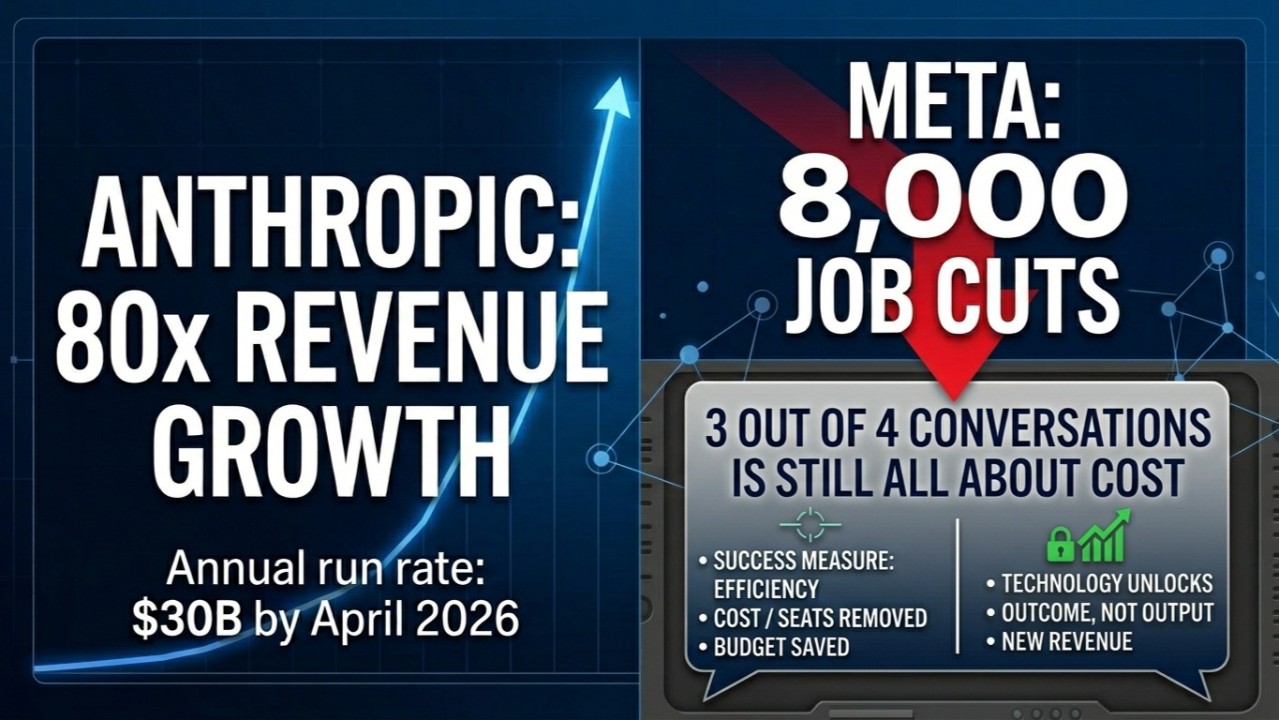
Since that article went live, the cuts have accelerated. Atlassian announced 1,600 redundancies, roughly 10% of its global workforce, framed as funding AI and enterprise expansion. Meta is reportedly preparing to reduce up to 20% of its workforce. The layoff tracker now shows more than 55,000 tech workers affected in 2026.
But something else happened in the same week that didn’t get nearly enough attention.
Whoop announced it’s hiring more than 600 people. Nearly doubling its workforce. Will Ahmed, the CEO, was direct: “Right now, companies are debating whether to hire more people or just invest in AI. We are doing both.”
Same week. Same industry. Completely opposite conclusions from the same facts about AI.
The wrong question
The question getting all the airtime is: how many fewer people do we need?
It is the wrong question.
The right question: given that execution cost just dropped by an order of magnitude, what can we do now that was previously impossible?
Economists call it Jevons Paradox. When a resource becomes dramatically more efficient, total consumption goes up, not down, because cheaper execution makes new applications viable. When steel got cheap, we didn’t build fewer things. We got skyscrapers, railroads, and automobiles. When computing got cheap, we got the internet, mobile, and cloud.
Daniel Priestley made a point recently that stuck with me. When YouTube disrupted television, Hollywood lost tens of thousands of jobs. But YouTube simultaneously created 500,000 to 600,000 new roles. Newspaper jobs dropped by 80% over 25 years. But the number of people doing journalism-like work has grown by 100x. The pie didn’t shrink. It exploded.
AI is the most dramatic efficiency improvement in the history of knowledge work. If the pattern holds, the total demand for insight, judgment, creativity, and domain expertise is about to expand dramatically. Not contract.
The data supports this. 69% of CEOs believe AI will lead to maintaining or increasing headcount. A European study of 12,000 firms found productivity rose 4% without reducing headcount. Ahmed at Whoop isn’t an outlier. He’s early.
There is also something worth noting. For a long time, blue collar work like plumbers, electricians, and bricklayers has been devalued relative to white collar knowledge work. The pendulum may be about to swing. When AI can draft contracts, write code, and analyse data, the work that requires physical presence and manual skill becomes relatively scarcer. We could be approaching a world where plumbers regularly earn more than lawyers, simply because the nature of the economy has changed.
What the new work actually looks like
When organisations stop using AI purely for headcount reduction, six structural shifts emerge. I’ve been tracking these in the organisations I advise, informed by thinkers like Nate B Jones whose work on AI expansion strategy has been among the sharpest I’ve seen.
Three matter most for skills:
Iteration compresses from months to days. Four learning cycles a year becomes two hundred. The cost of a failed experiment drops from a quarter of roadmap capacity to a day of compute. The bottleneck shifts from “can we build it” to “should we build it.” That is a human question.
Domain experts become builders. There are 36 million software developers worldwide. There are hundreds of millions of domain experts who know exactly what software should exist but can’t build it. Platforms like Lovable, Bolt, and Replit are dissolving the translation layer. Shopify saw this firsthand: when they deployed AI coding tools company-wide, the fastest-growing adoption was finance, sales, and support. Not engineers.
The market for ambition expands. Companies routinely ignore a $10 million market because the engineering team costs $3 million. Drop execution cost by 10x and those calculations flip. Whoop isn’t hiring 600 people for the same work. The opportunity set just expanded.
The skill underneath all six
Notice what they have in common. Every single one moves the bottleneck away from execution and toward judgment.
Who decides which of the two hundred experiments to run? Judgment. Who knows what the warehouse floor looks like when two conveyor lines jam? Domain judgment. Who sees the $10 million niche nobody else is serving? Judgment.
This is the skill that survives the restructure. Not technical execution. Not process navigation. Not stakeholder management. Judgment.
The ability to synthesise incomplete information, apply domain knowledge, weigh tradeoffs, and decide what to do. Quickly. Without waiting for a committee.
Think of it like farming. AI is very good at doing the middle work. It’s not good at knowing what to do in the first instance, or knowing when to stop and take it to market. The farmer knew when to plant. The soil did the value creation. The farmer knew when to harvest. Define the problem. Evaluate the output. AI handles everything in between.
Five average performers with AI tooling don’t outperform a traditional team. Five people with exceptional judgment, deep domain knowledge, and the ability to direct AI at the right problems absolutely can. The shift isn’t about smaller teams. It’s about judgment density.
The skills that compound judgment
Judgment doesn’t operate alone. Four adjacent capabilities amplify it, and they share one trait: they are irreplaceably human.
Entrepreneurial thinking. Not starting a company. Thinking like someone who starts things. Spotting opportunities, running fast cheap experiments, validating before committing. In a world where execution cost approaches zero, this becomes the most transferable skill a person can have.
Lived experience as intellectual property. AI has vast data and zero experience. It cannot tell you what it felt like to sit across from a lottery winner the week after their life changed. It cannot describe the chaos of a warehouse floor at shift change with the authority of someone who has stood in it. Every person carries knowledge that is uniquely theirs. The operations lead who has navigated three supply chain crises. The teacher who can read the exact moment a child goes from confusion to comprehension. These are personal playbooks. In a world flooding with AI-generated content, they are the scarcest form of intellectual property.
Going wide, not narrow. The industrial age rewarded specialisation. AI changes the calculation. Innovation comes from connecting ideas that haven’t been connected before. Steve Jobs brought calligraphy into computing and invented fonts. The rare combination is the competitive advantage.
Curiosity and agency. The people thriving in this transition have a positive relationship with disruption. They pick up new tools without waiting for permission. That mindset is worth more than any specific technical skill right now.
The honest part
Many of the skills the old structure rewarded are not the skills the new structure needs most. The brilliant stakeholder manager. The coordinator keeping fifteen workstreams aligned. These were genuinely valuable. Nobody should feel ashamed of building a career on them.
But in a team of five with AI handling execution, the coordination workload shrinks. The new structure doesn’t need glue. It needs spark.
This isn’t a verdict. It’s a signal to start building new muscles now. The good news: judgment isn’t fixed. It can be developed. The person who spent ten years deep in a domain but never touched code now has a direct path from their expertise to building things. The transition isn’t comfortable. But it’s possible, and it’s worth embracing now rather than waiting until the restructure decides for you.
What this means for you
If you’re a leader: create conditions for judgment to develop. Give people real problems. Reward those who define problems independently, even if their solutions aren’t perfect yet.
If you’re an individual contributor: what do you know that an AI doesn’t? What domain expertise has been trapped behind process and hierarchy? Start there. Build a prototype of the thing you’ve been describing in meetings for years.
If you’re a domain expert who has never coded: your moment is arriving. The translation layer that kept you locked out of building is dissolving. You don’t need to become an engineer. You need to describe what should exist and work alongside AI to make it real.
If you’re thinking about your career broadly: build a personal brand. Not to become an influencer. To position yourself so the right people know who you are and what you bring.
The imagination failure
The biggest risk right now is not technological disruption. It’s a failure of imagination. The layoff spreadsheet exists. The expansion case, for most companies, doesn’t.
Priestley makes a specific point about this. A successful software company used to require 50 employees, $5 million in funding, and 10,000 customers. When AI drops those requirements to two people and 500 customers, what happens isn’t fewer software companies. It’s millions of tiny, profitable, niche businesses that never could have existed before. The pie doesn’t just expand. It fragments into a million new shapes.
The companies that break out of the doom frame first won’t just get a head start. They’ll get the whole race.
The skill that survives the restructure is judgment. And judgment isn’t a trait you’re born with. It’s built through experience, domain depth, and the willingness to make decisions under uncertainty. You’ve been developing it your whole career, even if nobody called it that.
The question isn’t whether you have it. It’s whether you’re willing to lean into it now.
Let’s talk
I’m having these conversations every week now with boards, leadership teams, and individual operators navigating this transition. If any of this resonated, connect with me here or DM me. I’m especially keen to talk with boards and leadership teams working through this right now, but the conversation is open to anyone thinking seriously about it.
The best ideas are coming from the conversations, not the spreadsheets.
First published on LinkedIn, 17 March 2026.